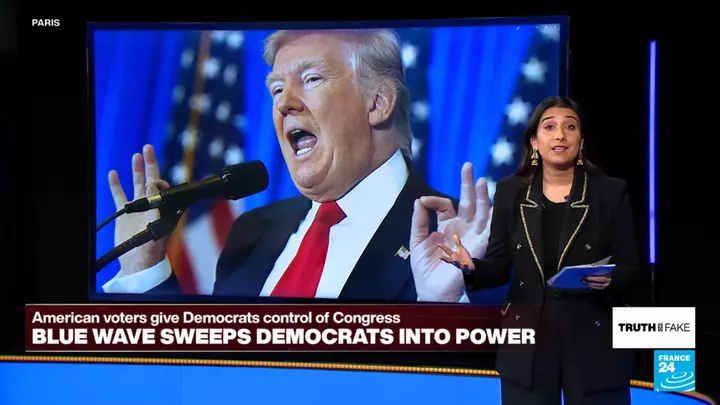
Donald Trump has repeatedly accused the media of spreading “fake news”. But since returning to the White House, the US president has continued to make false and misleading claims himself, while increasingly using artificial intelligence to attack political opponents, promote his agenda and glorify his own image. From recycling conspiracy theories about the 2020 election to making misleading claims about immigration and foreign conflicts, Trump's second term has seen a steady stream of disputed statements and online attacks, particularly attacks against his political rivals or those who disagree with him.
One of his most frequent targets has been his predecessor, Joe Biden. Trump has repeatedly referred to the former president as “Crooked Joe” or “Sleepy Joe”, blamed him for a range of political problems and shared AI-generated images negatively depicting him. A review found that Trump mentioned his predecessor around 900 times between returning to office and September 2026.
Former president Barack Obama has also been a frequent target. Trump came under widespread criticism after sharing a racist AI-generated video depicting Barack and Michelle Obama as apes, later claiming he "didn't see" that part of the clip. Other figures targeted by the president include Democratic politicians Nancy Pelosi and California Governor Gavin Newsom, as well as foreign politicians: like Italian Prime Minister Giorgia Meloni, after Trump shared an AI-edited image appearing to show her gazing adoringly at him.
Even Pope Leo has been drawn into Trump's online attacks. In a late-night Truth Social rant, the US president criticised the pontiff as “weak on crime”, questioned his positions and said he preferred the Pope's brother due to his MAGA stance. Artificial intelligence has become an increasingly prominent feature of Trump's digital presence.
The president has shared a series of AI-generated images and videos glorifying himself, portraying himself as everything from a king and Superman to the Pope. Some of the posts have been designed to mock his opponents. One depicted Trump dropping excrement on protesters taking part in the “No Kings” demonstrations.
Among the most controversial was an image showing Trump in a Jesus-like pose, apparently healing a sick man in a hospital bed. The post prompted criticism from Christians and Catholic conservatives, including some of his own supporters.Trump rejected comparisons with Jesus, blaming the “fake news media” for the controversy and saying he thought it was "him as a doctor". AI-generated content has also been used to reinforce his political messaging.
Extract — continue reading at the source.