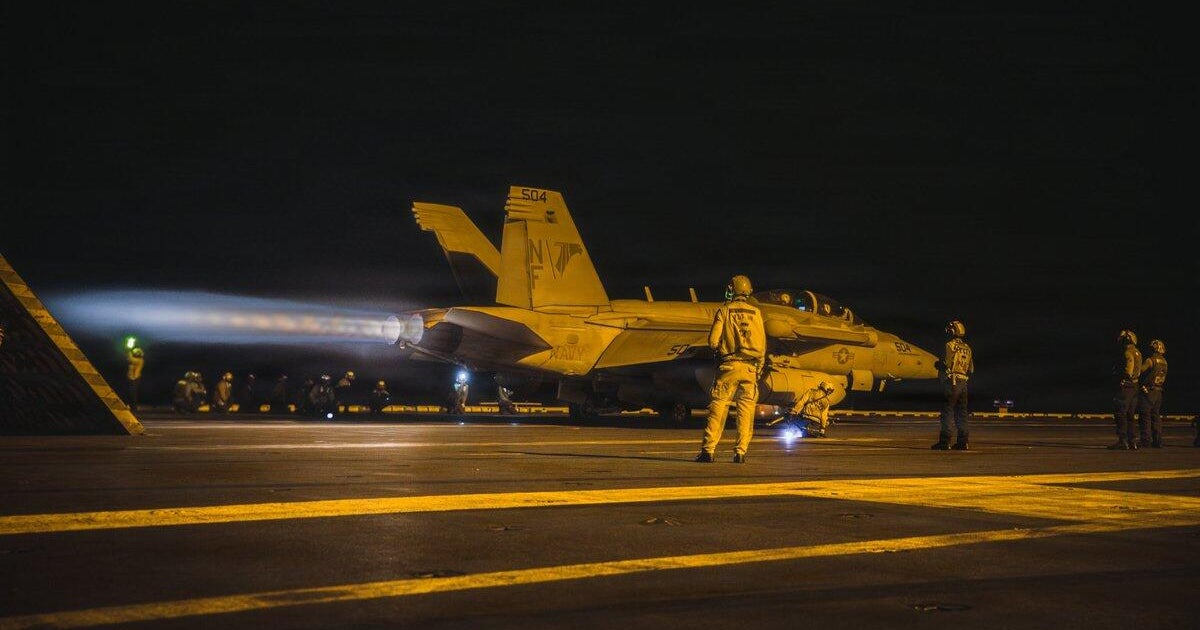
Ambassador to the United Nations Mike Waltz has said the war with Iran could drag on for another year. In an interview with the Financial Times published Friday, Waltz said the U.S. could still be fighting the war President Trump initially said would last "four to five weeks" 12 months from now. Waltz told the FT the U.S. will not have achieved its key goals in Iran until the country disposes of its highly enriched uranium and accepts a "meaningful agreement on their domestic enrichment." "I'm not going to put out hypotheticals.
One would hope that they'll come to the table in a meaningful way before that," Waltz said, referring to the possibility of another year of war. Navy can maintain this blockade [on Iranian ports] for the foreseeable future," and said the administration was still "tightening" its economic pressure campaign against Iran. Trump and Israeli Prime Minister Benjamin Netanyahu have renewed their threats to launch new strikes on Iran after the U.S. midterm elections on Nov. 3.
Foreign ministers from seven nations in Europe, the Middle East and elsewhere will hold talks in Istanbul Friday focused on the Strait of Hormuz and the interlinked crises in the Middle East, as well as the Ukraine war. Ministers from the so-called E3 group – Britain, France and Germany – will meet counterparts from the newly created R4 group, composed of Turkey, Saudi Arabia, Pakistan and Egypt, to discuss the Israel-Palestinian crisis, developments in Yemen and the Strait of Hormuz, and ways to end the Russia-Ukraine war, a Turkish foreign ministry source told AFP. British Foreign Minister Ed Miliband's office said the talks would revolve around "the Strait of Hormuz and the situation in Saudi Arabia," as the Saudis back Yemen's beleaguered government in its decade-long civil war, which has flared up amid the U.S. war on Iran.
"Despite positive progress from the U.S. and regional partners, passage through the Strait remains under threat, with traffic through the waterway sharply down on pre-war levels," a U.K. foreign ministry statement said. It said Miliband would "advocate for a diplomatic solution to the crisis that restores full navigational rights and freedoms" and stress "how Iranian tactics are being replicated across the region, with attacks on Saudi Arabia further destabilizing the region and increasing pressure on vital waterways and global chokepoints, such as Bab el-Mandeb and the Suez Canal." "The U.K. is stepping up to help stabilize the region, having this week committed RAF Typhoons to defend Saudi Arabia from Houthi attacks in their airspace," it added. The president of Saudi state-owned oil company Saudi Aramco, whose facilities have been targeted by Yemen's Iran-backed Houthi militants repeatedly for weeks, says the amount of oil moving through a pipeline that bypasses the Strait of Hormuz has more than tripled.
The East-West pipeline's capacity has surged from 2 million to 7 million barrels each day, President and CEO Amin Nasser said in an interview with Saudi-owned television Al Arabiya Business. Built in the early 1980s, the pipeline has played a crucial role in Saudi Arabia's ability to export oil amid disruption to shipping via the Strait of Hormuz during the Iran war. It carries crude from Saudi oil fields and production facilities in the east, on the Persian Gulf, to the Yanbu oil terminal on the Saudi Red Sea coast on the other side of the vast kingdom, from which it can be shipped to global markets.
That route, which, unlike the Gulf, has two available exits, has also been threatened and attacked by the Houthis, who have vowed to stop Saudi shipments via the Red Sea's southern gateway, the Bab el-Mandeb Strait. Nasser said Saudi Aramco has used drones to assess damage caused to infrastructure, including sites key to the East-West pipeline, by Houthi attacks, and to help with firefighting. As crude oil prices hit their highest levels since May, President Trump accused Iran on Thursday of lying about attacks on tankers in the Strait of Hormuz to drive up global energy prices.
Extract — continue reading at the source.