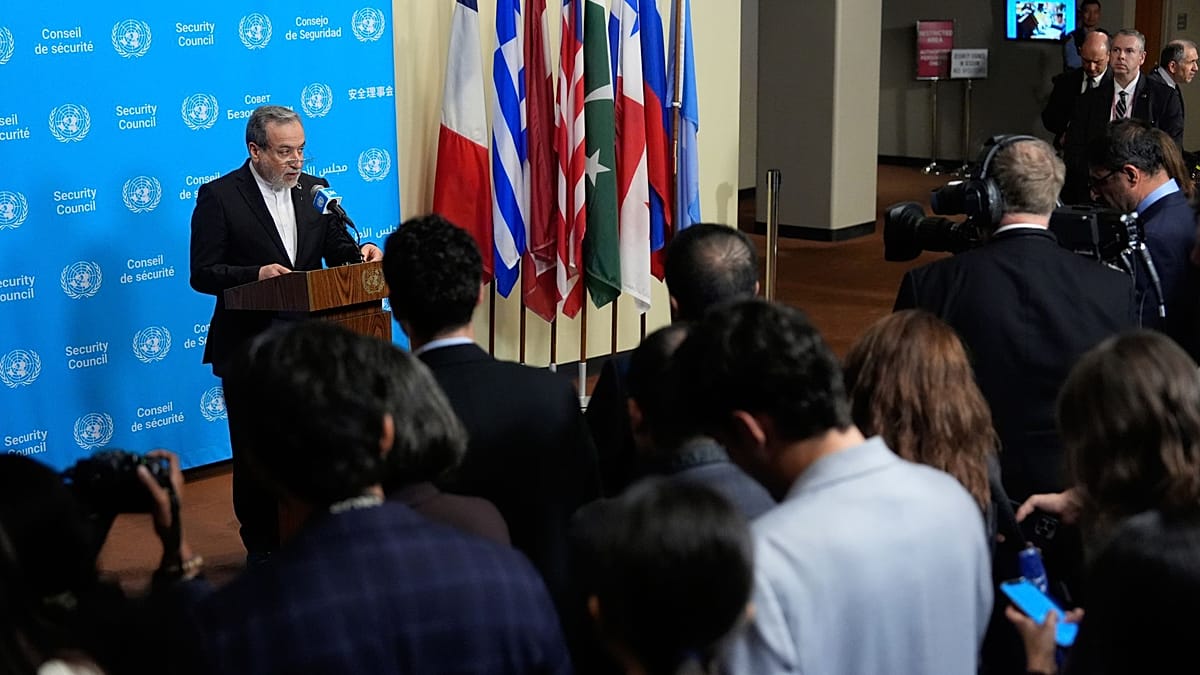
Turkiye’s President Recep Tayyip Erdogan has called for the five permanent members of the United Nations Security Council (UNSC) to lose their veto power, arguing that the current veto system is “unjust” and hinders “global stability and peace”. The call comes as the UNSC, which has five permanent members and 10 rotating, non-permanent members, remains deadlocked on many issues – from Israel’s war on Gaza to Russia’s war in Ukraine and the Strait of Hormuz. The US, one of the five permanent members, has vetoed seven resolutions related to the Israeli-Palestinian conflict over the past three years, including five calling for a ceasefire in Gaza.
Russian vetoes have prevented the UNSC from passing any firm resolutions on the war in Ukraine. Speaking to journalists in New York on Thursday, Erdogan said, “Let the veto mechanism be abolished… Let us move from a UN model that protects only five members to a mechanism that encompasses all members”. So, could Erdogan’s call become a reality and what would abolishing the veto mean for the UNSC?
It is a special power to veto any substantive resolution, granted to the body’s five permanent members – the US, the UK, France, Russia and China. It means that even if 14 of 15 UNSC members vote in favour of a resolution, just one veto from any of the five permanent members (P5) can tank it. Erdogan has called for a complete overhaul of the UNSC.
That includes ending permanent membership of the council and eliminating the veto power. Laying out his case in a September 22 article published by Bloomberg, Erdogan wrote that the UNSC’s current structure, developed eight decades ago, no longer meets the needs of a changing world and that a single country should not be able to block the wishes of the broader international community. Erdogan also called for greater powers for the UN General Assembly (UNGA), which he said should elect all UNSC members for set terms.
Countries seeking to serve on the council would therefore have to “regain the confidence of the majority of member states through elections”, he said. Erdogan lobbied for this initiative during his recent address to the UNGA, saying “a system in which the will of more than 190 countries is subject to the whims of five countries is neither fair nor capable of fully establishing trust”. Formally ending the veto would require an amendment to the UN Charter.
Under Article 108, that requires approval by two-thirds of the UNGA and ratification by two-thirds of UN members, including all five permanent members. In other words, the P5 would have to sign off on giving up their own veto power. In 2015, France and Mexico tabled a proposal urging the P5 to suspend their vetoes on resolutions involving mass atrocities, such as genocide and crimes against humanity.
Extract — continue reading at the source.