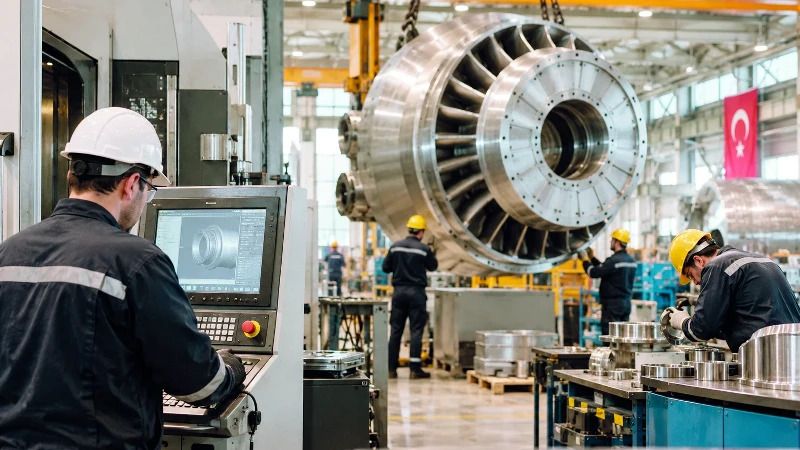
Türkiye’s industrial sector is entering a new era of competition, with ambitions extending beyond increasing production capacity toward becoming a manufacturing powerhouse that develops high technologies and supplies products to global supply chains. Seyit Ardıç, Chairman of the Board of the Ankara Chamber of Industry (ASO), said that investment, productivity and technology are the foundations of moving up the industrial value chain, stressing that Türkiye needs to increase its production and export capacity, particularly in high-technology products. Ardıç said Türkiye’s position in the global manufacturing race can no longer be measured solely by production volumes.
He noted that the level of technology and the amount of added value generated have become increasingly decisive. Ardıç said that during the first seven months of 2026, high-technology products accounted for only 3.7% of Türkiye’s manufacturing industry exports, while their share of imports stood at 12.1%. He added that Ankara had exceeded the national average in high-technology product exports, with a share of more than 13%.
He emphasized that the goal of Türkiye’s industrial sector should not simply be to produce more, but to produce higher levels of technology and greater added value. Ardıç said nuclear energy represents a strategic area in Türkiye’s ambition to develop technology and stressed that the nuclear sector should not be viewed solely in terms of electricity generation. He explained that the nuclear supply chain creates a broad industrial ecosystem covering engineering, speciality steel, valves and pumps, welding technologies, software, quality systems, testing and certification.
Recalling that ASO established NÜKSAK in 2017, Ardıç said the initiative was designed to help companies reach international quality and certification standards through clustering and gain access to global supply chains. Ardıç particularly emphasized that Türkiye’s objective in the nuclear industry is not limited to supplying goods and services to power plants that will be built in the country. He said Turkish companies need to take the engineering, quality, manufacturing and certification capabilities they acquire in the nuclear sector into international projects.
He stressed that genuine localization should not be limited to using a domestically produced product in a particular project. The ultimate goal, he said, should be to make the capability to develop and manufacture such products permanent and to be able to sell them in global markets. Here we are to serve you with news right now.
It does not cost much, but worth your attention. Choose to support open, independent, quality journalism and subscribe on a monthly basis. By subscribing to our online newspaper, you can have full digital access to all news, analysis, and much more.
Extract — continue reading at the source.