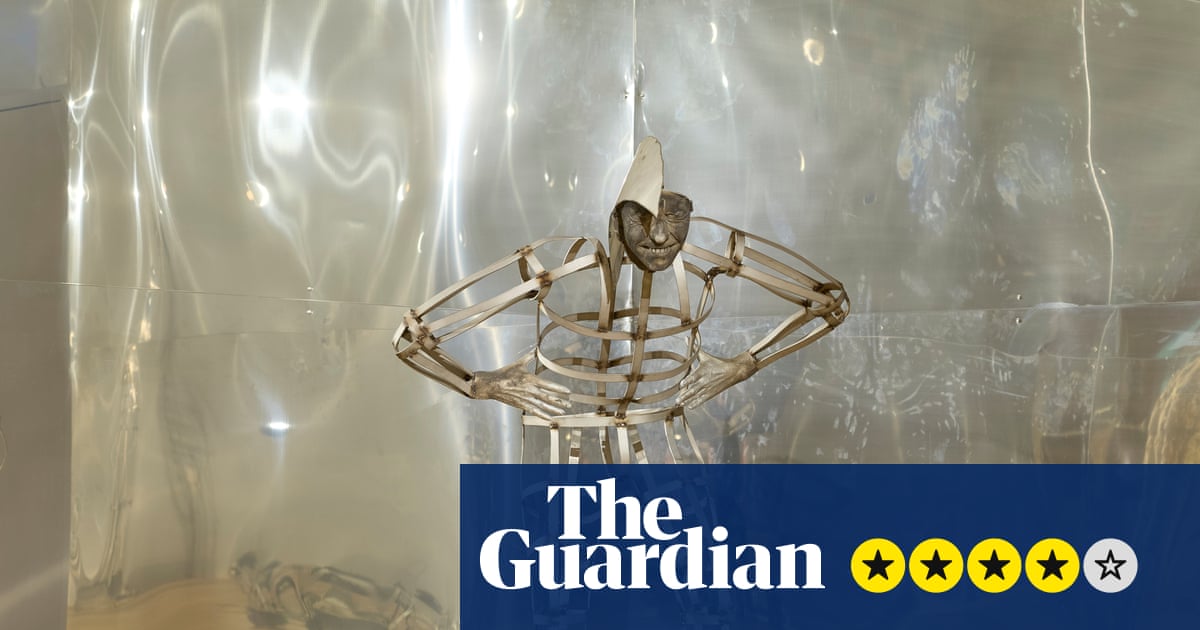
The Turner prize is most exciting when you passionately support one of the artists and want to convince everyone she’s a genius. In this year’s show at Middlesbrough Institute of Modern Art, I felt that thrill so strongly, I want to get a T-shirt made to support my artist like the Boro scarves and banners you see around here. Kira Freije has her own floor, separated by a tall flight of stairs from the three other shortlisted artists, because apparently the fine watery mist in her installation could damage their fragile materials.
Yet setting her apart seems like a statement and it’s justified. She shows 33 lifesize statues of tragicomic steampunk cyborgs, individual works but gathered in a vaporous apocalyptic wasteland, with an impact and resonance that’s on a level of its own. Our faces and hands, Freije understands, are what make us human: these are the only fully human thing left about her figures, as if a rogue AI has replaced the rest.
They have hollow frames for bodies, hard metal replacements for flesh, bone and soul but with life-cast faces soliciting empathy. You walk among them, come close to gaze into an anguished visage or at a fallen figure desperately clutching at another’s steel ankle. This is a pathetic world where humanity is holding on as a ghost in the machine.
It’s coarse, passionate stuff, with rusty buckets of fetid liquid and a mangy sofa in the bronze steamy glow undercutting any sense of shiny futurism. It’s the way we live now. Freije’s cyborgs touch one another tenderly, offer support, cuddle steel-framed pets.
The only surviving things that matters, says this stunning installation, are love and compassion. I’m sorry for rushing straight to my favourite. I will try to do the others justice.
I was really engaged by Simeon Barclay. His room is a dramatic tableau, reminiscent of immersive theatre company Punchdrunk, that leads you past giant photographs of a man reading a tabloid newspaper – “Leave ’em to die” blares the headline – and a glowing melancholy landscape, then through a labyrinth beneath a neon sign into a central space suggesting a living room. Barclay’s recorded voice declaims poetry denouncing a northern, working-class man – his father? – who lost his way in hardened, selfish masculinity.
Extract — continue reading at the source.


.png)


