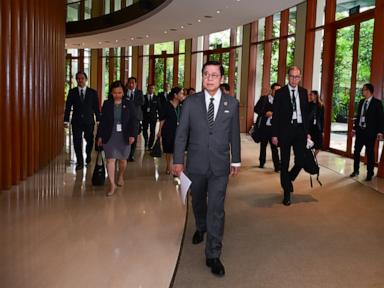
Trade and Development Agency on Monday announced funding for a feasibility study on a new trans-Pacific submarine cable linking the U.S. with Thailand and as many as five other Southeast Asian nations, as Washington seeks to expand secure digital infrastructure in the region. The proposed cable that could extend up to 11,500 miles (18,507 kilometers) long would connect Thailand with the U.S. via Indonesia, Malaysia, the Philippines, Singapore and Vietnam, “while avoiding the South China Sea and other routes that carry security risks,” the agency said in a statement. The project would be built to U.S. engineering standards and is intended to replace Thailand’s aging subsea connection to the United States.
Submarine Cable System, or THUS, will “strengthen the resilience and diversity of our international networks, support the growth of Thailand’s data center, cloud, and AI sectors, and expand affordable connectivity,” said Col. Sanpachai Huvanandana, President of the Thai state-owned National Telecom Public Company. The U.S., facing competition from China, has made a concerted effort in recent years to expand its role in building subsea cables, which carry nearly all international internet traffic.
The Indo-Pacific is an increasingly important arena for such networks as countries build out digital infrastructure, while Beijing’s sweeping claims in strategic waterways, including the South China Sea, have complicated efforts to lay new cables. Nearly two dozen international cables are expected to be built across the Pacific between 2022 and 2030, according to the International Institute for Strategic Studies. While the USTDA didn’t offer an expected price for the project, other estimates show the aggregate cost of new undersea cable construction is expected to reach over $14 billion between 2025 and 2027.
Last week, the USTDA announced plans to support the expansion of port facilities at the strategic Subic Bay in the Philippines and establish a nationwide public Wi-Fi network. The agency will also develop liquefied natural gas and nuclear projects there to lower electricity costs and attract businesses into an investment belt that’s seen to counter China’s supply-chain influence.
Extract — continue reading at the source.