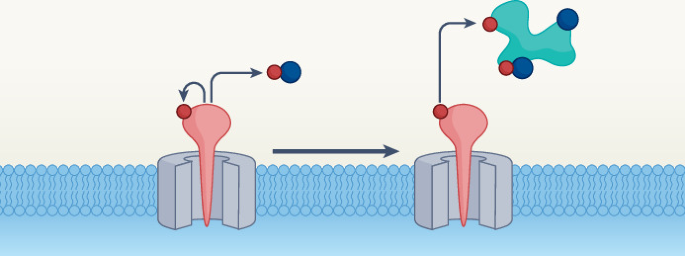
Studies of Parkinsonism-associated genes have shed light on the molecular mechanisms of mitochondrial quality control. Among these, the PINK1–Parkin pathway links mitochondrial damage to selective mitochondrial turnover, and loss of either factor causes autosomal-recessive early-onset Parkinsonism. The initial model was straightforward: mitochondrial damage stabilizes PINK1, which phosphorylates and activates the E3 ubiquitin ligase Parkin.
However, one observation did not fit: phosphorylation of Parkin at Ser65 was important, but insufficient — even a phosphomimetic Parkin mutant remained dependent on PINK1. An additional signal was required. In addition to Parkin’s phosphorylation in the ubiquitin-like domain at Ser65, PINK1 phosphorylates ubiquitin at the equivalent residue (pUb-Ser65).
Upon mitochondrial depolarization, pUb-Ser65 accumulates in a PINK1-dependent manner: it stimulates ubiquitin discharge from the E2 enzyme onto Parkin (autoubiquitylation) and allosterically enhances Parkin’s catalytic activity, thereby providing the missing link between PINK1 activity and full Parkin activation. Once conjugated by active Parkin onto mitochondrial substrates, pUb-Ser65 further recruits PINK1–Parkin, generating a self-amplifying loop that drives mitophagy. This is a preview of subscription content, access via your institution Access Nature and 54 other Nature Portfolio journals Get Nature+, our best-value online-access subscription Receive 12 print issues and online access Prices may be subject to local taxes which are calculated during checkout Koyano, F. et al.
Ubiquitin is phosphorylated by PINK1 to activate parkin. Nature 510, 162–166 (2014) Kane, L. PINK1 phosphorylates ubiquitin to activate Parkin E3 ubiquitin ligase activity.
Cell Biol. 205, 143–153 (2014) Article PubMed PubMed Central Google Scholar Kazlauskaite, A. et al. Parkin is activated by PINK1-dependent phosphorylation of ubiquitin at Ser65. J. 460, 127–139 (2014) Institute of Molecular Cancer Research, University of Zurich, Zurich, Switzerland The author declares no competing interests.
Ubiquitin phosphorylation opens a hatch to a code still largely undeciphered. Nat Rev Mol Cell Biol (2026). https://doi.org/10.1038/s41580-026-01043-2 DOI: https://doi.org/10.1038/s41580-026-01043-2
Extract — continue reading at the source.


