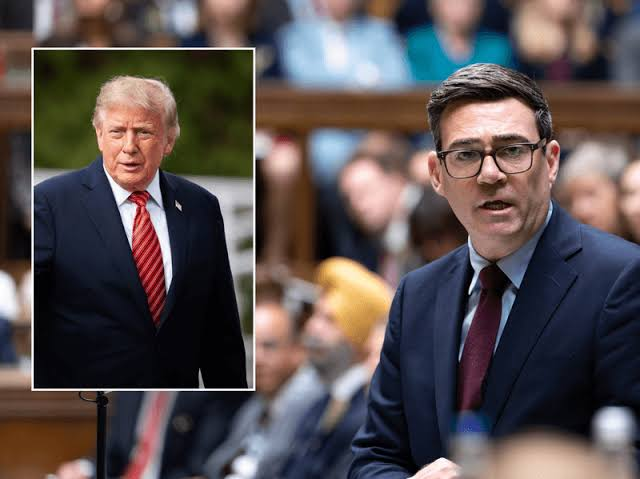
The UK government has pushed back against US President Donald Trump's call for Irish unification, insisting that there is currently insufficient public support in Northern Ireland for a referendum on the territory's constitutional future. Trump said during his visit to Dublin on Saturday that he would “love to see” Ireland unified and suggested that reunification was ultimately inevitable. It may as well happen now.” The comments put Trump at odds with the UK government's position on a potential border poll in Northern Ireland.
Downing Street said Prime Minister Andy Burnham's position had not changed and that there was currently no majority public support for another referendum. Under the 1998 Good Friday Agreement and the legislation underpinning it, a referendum on Northern Ireland's constitutional status is to be called if the UK Secretary of State has grounds to believe that a majority would vote in favour of a united Ireland. The decision therefore rests with the British government rather than being triggered directly by the US or Irish governments.
Burnham said earlier this month that there was no current majority support for another referendum, effectively ruling out a border poll under present circumstances. His position was reiterated by Downing Street following Trump's remarks. Trump acknowledged that the UK would have a role in any decision but nevertheless described Irish unification as a “fantastic” development.
The US president's intervention has already drawn criticism from unionist politicians in Northern Ireland, who argue that the territory's constitutional future should be determined by its own voters. Democratic Unionist Party leader Gavin Robinson said Northern Ireland's future would be decided by its people rather than by politicians in London, Dublin or Washington. The remarks have also been welcomed by Irish nationalists.
Sinn Féin president Mary Lou McDonald said Trump's comments showed that the debate over Irish unity had shifted and called on Martin to begin planning for reunification. Martin has previously called for greater clarity over the circumstances in which a border poll could be held, while stressing the importance of cooperation between Dublin, London and Northern Ireland's political parties. Trump's comments therefore inject a new international dimension into an issue governed by the Good Friday Agreement, which ended decades of conflict and established the principle that Northern Ireland's constitutional status can change only with the consent of a majority of its people.
Here we are to serve you with news right now. It does not cost much, but worth your attention. Choose to support open, independent, quality journalism and subscribe on a monthly basis.
Extract — continue reading at the source.