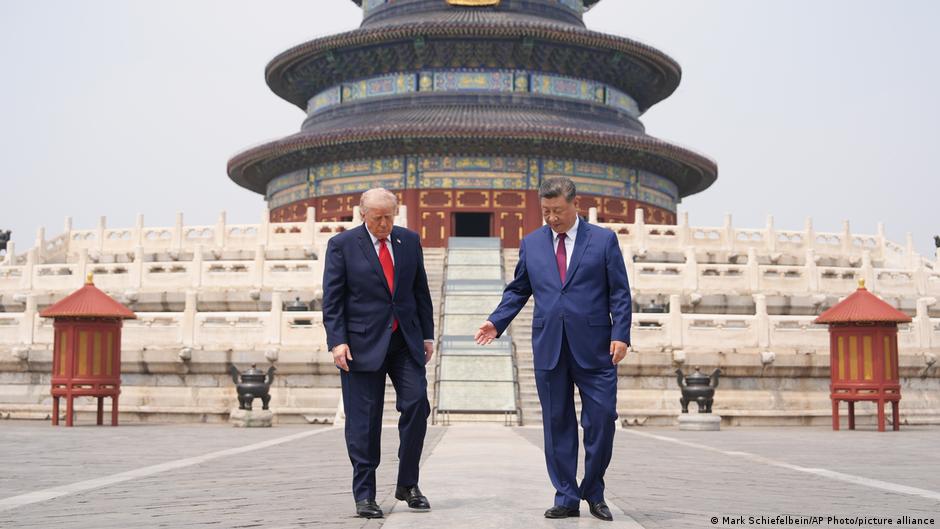
Last week, German and Chinese business leaders met in the German city of Düsseldorf for an economic dialogue. Although the panel focused on trade, and investment between China and Europe, ongoing US-China rivalry was the elephant in the room. As Xi Jinping and Donald Trump sit down in the US capital Washington this week, there is some hope that talks will show progress on alleviating the ongoing trade war launched by the US president.
The last time the two leaders met at a Beijing summit in May did not yield any tangible results. "The assumption in Beijing, and that's the way they're operating, is that China and the US will hold each other in check for the foreseeable future," Mikko Huotari, director of the Berlin-based China think tank MERICS, told a policy briefing last week. "Xi really doesn't need a breakthrough in Washington.
And the same is true for Washington. So we have this strategic stalemate situation, which I think is the best description of what we see currently." A deal could benefit Trump's Republican Party ahead of the important US midterm elections in November, but that outcome remains far from certain. "We will discuss everything,"Trump said about Xi's visit to the White House.
Beijing and Washington are competing on multiple levels, and nowhere is this rivalry more consequential than with artificial intelligence (AI). The US government prohibits the export of high-performance chips to China. Beijing, in turn, restricts the export of rare earth elements, which are indispensable for semiconductor production.
And amid concerns about the dangers of unregulated AI, there is some expectation that Xi and Trump will discuss AI guardrails during their talks. Xi has called for international cooperation on AI development, while Trump sees its regulation as a threat to the US' leadership in the field. After meeting with Chinese Vice Premier He Lifeng in New York on Sunday, US Treasury Secretary Scott Bessent said that US and Chinese officials have already discussed creating a "notification mechanism" to share information about AI-related security incidents.
To view this video please enable JavaScript, and consider upgrading to a web browser that supports HTML5 video From a European perspective, both China and the US are currently considered difficult partners. The second "China shock … is already here" in Europe, said European Commission President Ursula von der Leyen in her 2026 State of the Union address last week. The first "China shock" came 25 years ago, triggered by China's accession to the World Trade Organization (WTO), when inexpensive "Made in China" products began to flood the global markets.
Extract — continue reading at the source.