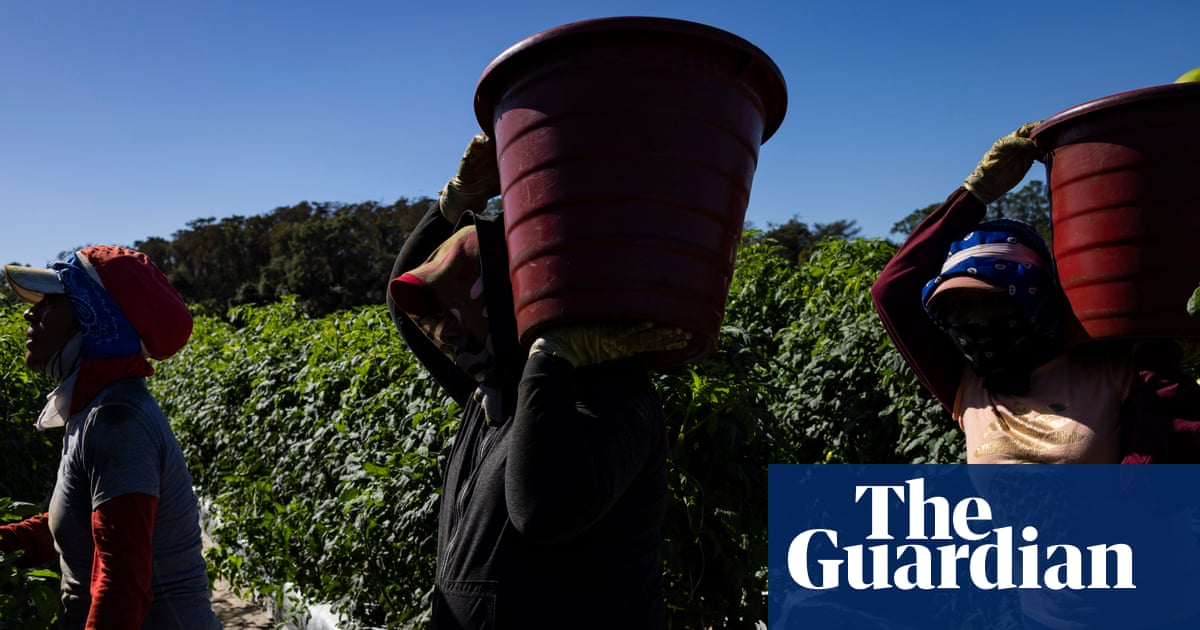
Benitez began working in tomato fields in Immokalee, Florida when he was just 16, and in the early 1990s went on to help found the Coalition of Immokalee Workers (CIW), named after the major tomato growing region in south-west Florida. Today, CIW’s fair food program has some of the strongest heat protections for workers in the country, and its approach is being emulated by other groups – in the US and beyond – as federal, state and local efforts to protect people from extreme heat stall. The program’s protections were hard won after years of boycotts, hunger strikes and protests against food corporations.
The model, described as “market-based enforcement” by academics, works by targeting the reputation of the known brand-name of a company – say a fast-food retailer – to improve conditions rather than smaller entities in the supply chain. Retailers agree to pay a small premium to buy from farms that comply with a worker-protection code of conduct. Farms that violate the code can lose their preferred status, giving workers a powerful way to enforce protections without relying on government regulators.
Miami-based WeCount is among the labor groups that are now adopting the fair food program model for other hot, low-wage jobs. Worker organizations in dairy production in Vermont, construction in Minnesota, sugarcane production in India, and banana production in Ecuador have created similar human rights initiatives. Florida produces about 70% of all indoor plants sold in the US.
The workers who grow these plants were exposed to temperatures over 100F (37.8C) this summer and reported heat-related symptoms and dehydration, said Oscar Londoño, the co-executive director of WeCount, a human rights organization led by immigrant workers and families in south Florida. In September, 24-year-old Obed Azahel Hernandez Perez died from extreme heat exposure while harvesting sweet potatoes in Chickasaw county, Mississippi. And, last year, 47-year-old Marco Antonio Hernandez Guevera died after collapsing from the heat on his first day in the field at a tomato farm in Immokalee.
In Texas, hospitals are seeing an increasing number of cases of kidney disease among outdoor workers, which research suggests could be linked to prolonged exposure to extreme heat. For years, WeCount advocated for heat protections for workers at the state level. Despite largely being symbolic (it did not include enforcement or penalty measures), the legislation died in committee every year, Londoño said.
In 2021, the organization, along with labor partners across the state, launched the “que calor” campaign, meaning “how hot”, with the goal of securing heat protections for workers. Two years later, WeCount set its sights on passing a local ordinance. Unlike the drafted state legislation, the county bill had strong enforcement in the form of monetary penalties to make sure there was industry-wide compliance, Londoño said.
Extract — continue reading at the source.