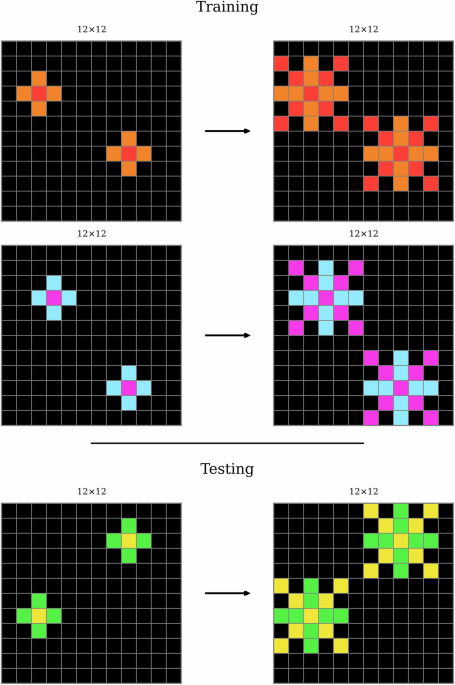
The Abstraction and Reasoning Corpus for Artificial General Intelligence (ARC-AGI) is a generative, few-shot fluid intelligence benchmark. Although humans effortlessly solve ARC-AGI, it remains extremely difficult for even the most advanced artificial intelligence systems. Inspired by methods for modelling human intelligence spanning neuroscience to psychology, we propose a cognitively inspired ARC-AGI solver.
Our solver integrates System 1 intuitions with System 2 reasoning in an efficient and interpretable process using neurosymbolic methods based on Vector Symbolic Algebras (VSAs). Our solver works by object-centric program synthesis, leveraging VSAs to represent abstract objects, guide solution search, and enable sample-efficient neural learning. Preliminary results indicate success, with our solver scoring 10.8% on ARC-AGI-1-Train and 3.0% on ARC-AGI-1-Eval.
Additionally, our solver performs well on simpler benchmarks, scoring 94.5% on Sort-of-ARC and 83.1% on 1D-ARC—the latter outperforming GPT-4 at a tiny fraction of the computational cost. Importantly, our approach is unique; we believe we are the first to apply VSAs to ARC-AGI and have developed one of the most cognitively plausible ARC-AGI solvers yet. Our code is available at: https://github.com/ijoffe/ARC-VSA-2025.
Two such problems often identified in the literature are sample-efficient learning and explicit reasoning8,9,10. Deep learning’s success requires vast amounts of often-labelled high-quality training data, making it ineffective in the sample-few regime. Additionally, deep learning systems struggle with representing explicit rules, sometimes manifesting in poor out-of-distribution generalization.
Vector Symbolic Algebras (VSAs), a neurosymbolic AI method introducing syntactic structure into high-dimensional distributed representations, hold promise to overcome these two limitations that ARC-AGI targets. VSAs specify high-dimensional vectors to represent structured low-dimensional data, discrete or continuous. Thus, instead of learning useful embeddings from huge datasets, a VSA can be used to encode data with desired inductive biases.
VSAs also define operators for the composition and systematic processing of data. Thus, instead of learning shortcut transformations that may generalize poorly to unseen inputs, a VSA, despite relying on distributed representations, can be used to express certain operations analytically. Additionally, VSAs support discrete search and neural learning, both of which are helpful for ARC-AGI.
Extract — continue reading at the source.


