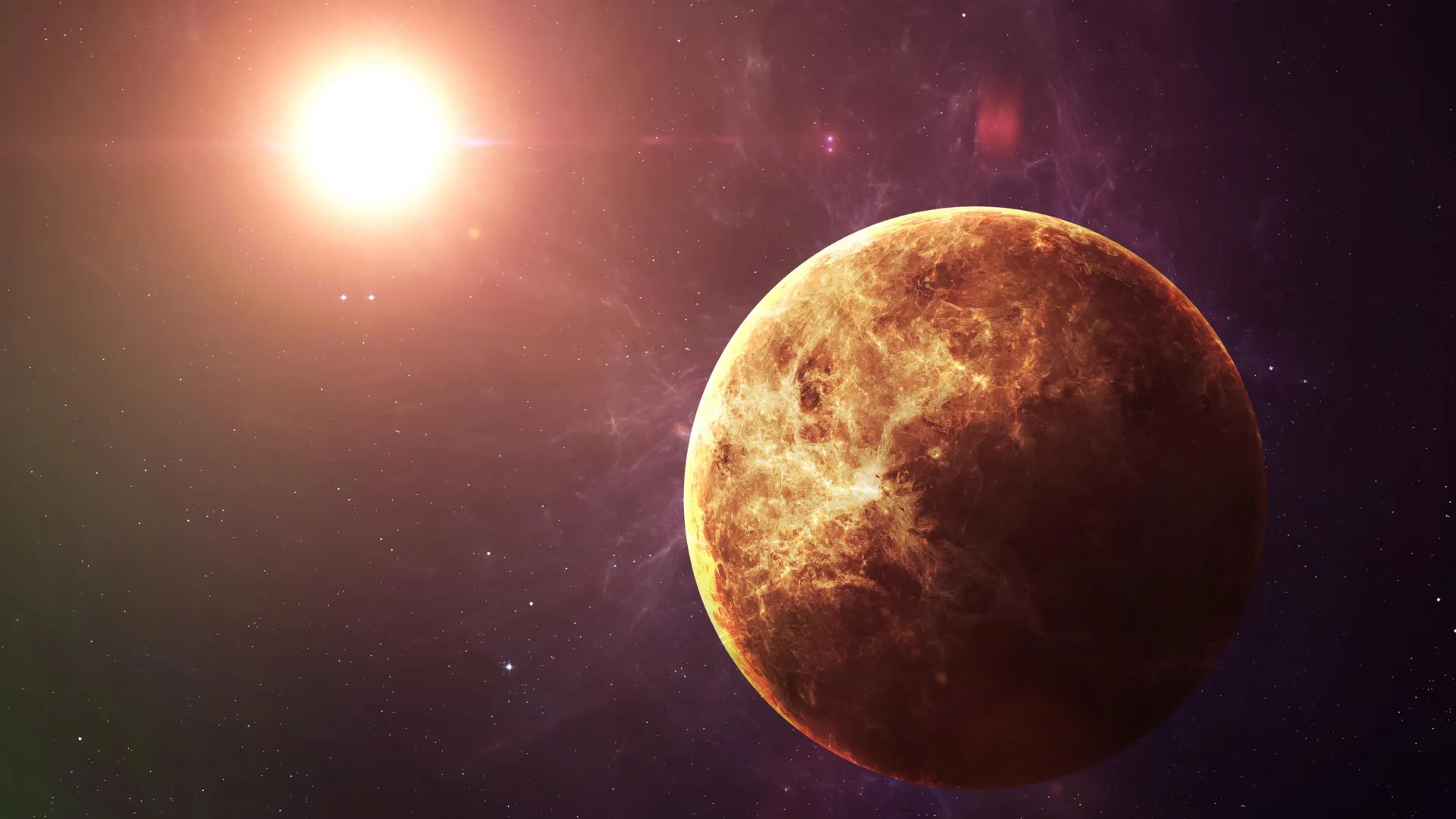
Scientists have puzzled for years over why Venus, despite being similar to Earth in size, mass, and overall structure, has no moon. New research from UC Riverside suggests a striking possibility: Venus may once have had a moon, only to eventually pull it back into the planet. Previous explanations generally focused on two possibilities.
One suggested that Venus once had a moon that was later destroyed by a massive impact. Another proposed that Venus simply never experienced the kind of collision that could have created a moon in the first place. A new study published in The Astrophysical Journal offers a different explanation.
According to the research, Venus may not have needed a dramatic external event to lose a moon. "My study shows Venus didn't require a catastrophe to arrive at what we can see today," said UCR astrophysicist and lead author Stephen Kane. "It turns out the gravity of the planet itself combined with the rate at which it spins naturally caused the moon to collapse on top of it." Scientists know that Earth's moon is gradually drifting farther from us because the Apollo 11 mission left mirrors on the lunar surface that allow researchers to measure the Earth-Moon distance with extreme precision.
"We know that the moon is slowly moving away from the planet, at a rate of around four centimeters per year," Kane said. That movement is closely tied to Earth's relatively rapid rotation. Our planet completes one spin in about 24 hours.
Some of the energy associated with that rotation is transferred to the moon, helping push it slowly outward over time. A single rotation on Venus takes about 243 Earth days. Because the planet spins so slowly, a moon around Venus would not necessarily migrate outward in the way Earth's moon does.
Instead, the combination of Venus' gravity and its sluggish rotation could cause the moon to gradually spiral inward until it collided with the planet. To investigate that possibility, Kane developed computer models that simulate how planets and moons interact through gravity. He first tested the model using Earth and the Moon, reproducing the known evolution of the system to confirm that the simulation behaved realistically.
Extract — continue reading at the source.


