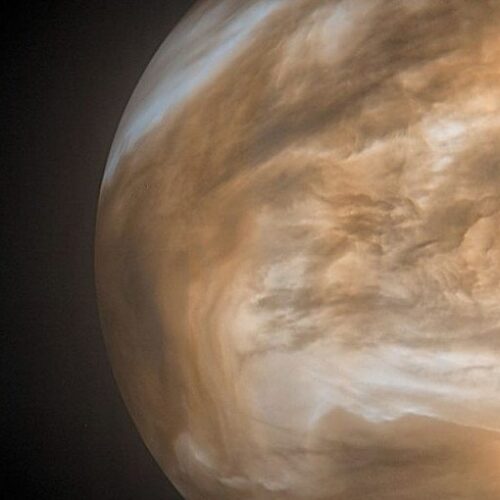
The yellowish “lower haze” at the bottom of its atmosphere was discovered by the Venera and Pioneer Venus probes in the 1970s. These spacecraft were some of the first to successfully send images of the planet back to Earth, but the haze they saw went unexplained for decades. Now the mystery Venus was keeping has been unveiled.
What nobody knew then was that the haze is an accumulation of particles from meteorites. Planetary scientist Hiroki Karyu and his research team at Tohoku University in Sendai City, Japan, finally figured out how the haze formed using a microphysical model. This type of model involves microphysics—the micro-scale processes that create clouds and precipitation on Earth and other bodies.
Venus is known as the most volcanically active planet in our Solar System, with signs of volcanism first observed by the Magellan spacecraft in the early 1990s. Recent studies discovered the planet is more volcanically active than previously thought, but the researchers found that ash belched out by Venusian volcanoes is not the source of haze particles. Surface dust was also ruled out.
Karyu found that even if there were much larger influxes of volcanic or surface dust on Venus, the particles would still not be able to interact with the atmosphere’s sulfur in the right way to form the haze.
Extract — continue reading at the source.