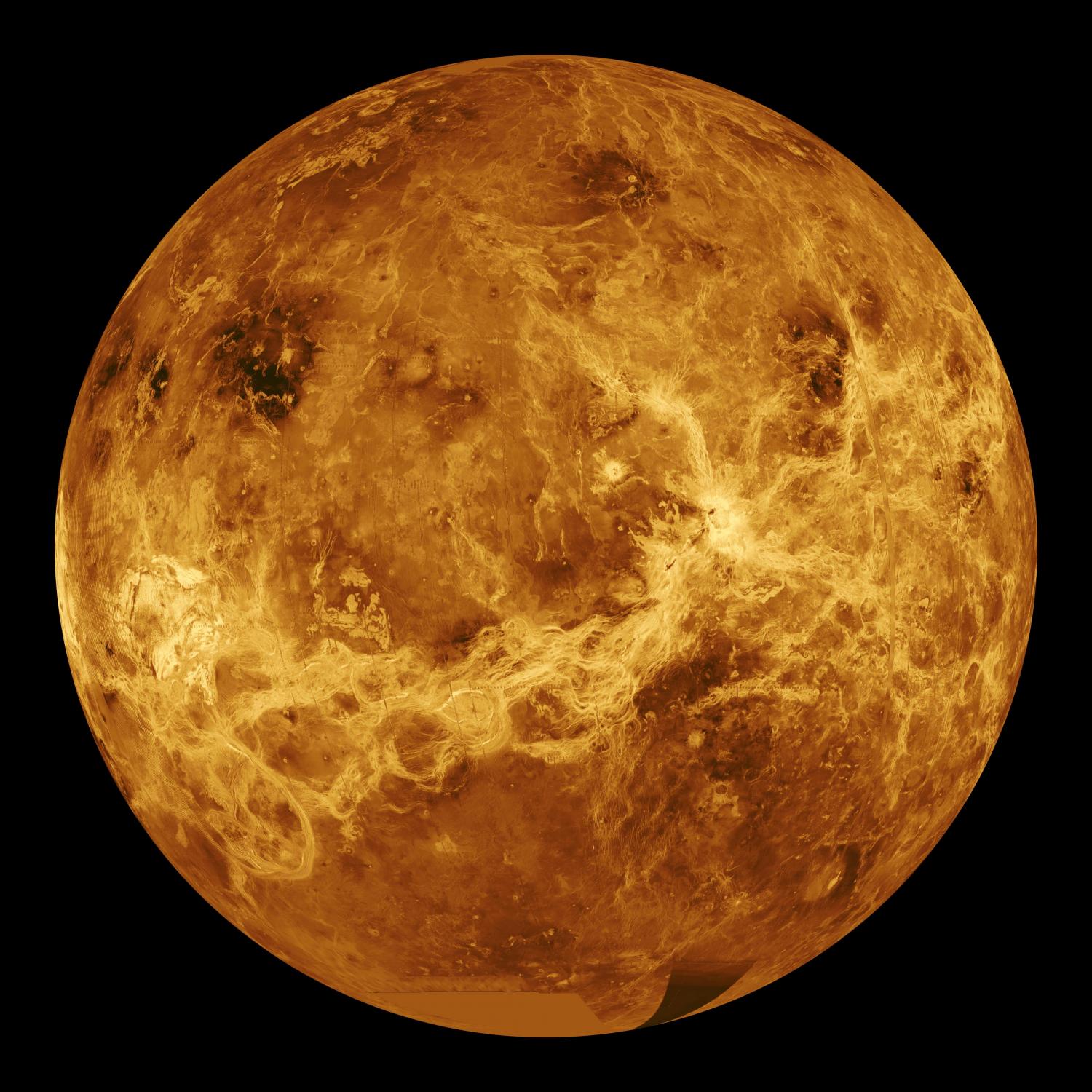
This article has been reviewed according to Science X's editorial process and policies. Editors have highlighted the following attributes while ensuring the content's credibility: Venus appears pale yellow in visible light, but ultraviolet images reveal dramatic dark and bright patterns moving with the planet's upper sulfuric acid clouds. Scientists have known about these markings for roughly a century, yet the chemical identity of the material responsible—the "unknown absorber"—remains unresolved.
An international research team has now placed new quantitative constraints on the properties of this mysterious absorber. By combining observations of Venus with radiative-transfer modeling, the researchers estimated how strongly the liquid inside Venus's cloud droplets would need to absorb light to reproduce the planet's observed ultraviolet and blue reflectance. The study, published in Astrobiology, approached the mystery from a new perspective.
It used a model to answer a question posed by lead author Dr. Jan Spacek: "If we were to collect Venus's cloud droplets into a spectrometric cuvette, how would the re-formed bulk liquid appear?" The difference between how a cloud looks and how its material looks when collected in bulk can be striking. Cigarette smoke, for example, appears white because its submicrometer particles scatter light very efficiently.
Yet when the smoke particles are collected in a flask, they form a dense suspension of burned tobacco—a tar-like sludge. A similar optical principle applies to Venus's clouds, as their particle size distribution is comparable to that of cigarette smoke. Thus, even though the clouds appear pale yellow to a remote observer, the liquid forming the cloud droplets might be surprisingly dark.
"Our model effectively asks what would happen if we could collect that cloud material into a cuvette and put it into a laboratory spectrometer," said lead author Spacek of the Foundation for Applied Molecular Evolution, U.S. "This is important, as light absorption in a bulk liquid may be correlated with the concentration of light-absorbing material in the solution." The researchers combined observations of Venus with a radiative-transfer model that accounts for multiple scattering by cloud droplets and atmospheric molecules. They translated the astronomical observations into a quantity routinely measured in laboratory UV-visible spectroscopy: the absorption coefficient of the bulk cloud liquid.
"The key is that Venus's cloud particles scatter sunlight very efficiently, so the brightness observed from space cannot be directly compared with the absorption of a bulk liquid measured in the laboratory," said Dr. Lee Yeon Joo of the Planetary Atmospheres Group within the Institute for Basic Science (IBS), South Korea, who performed the radiative-transfer model calculations in the study. "By accounting for the scattering and absorption by the cloud particles and atmosphere, the model allows us to estimate how strongly the liquid of cloud droplets itself must absorb light." Within the modeled 365–455 nm range, the required decadic absorption coefficient reaches approximately 1,278 cm-1 at 375 nm.
Extract — continue reading at the source.


