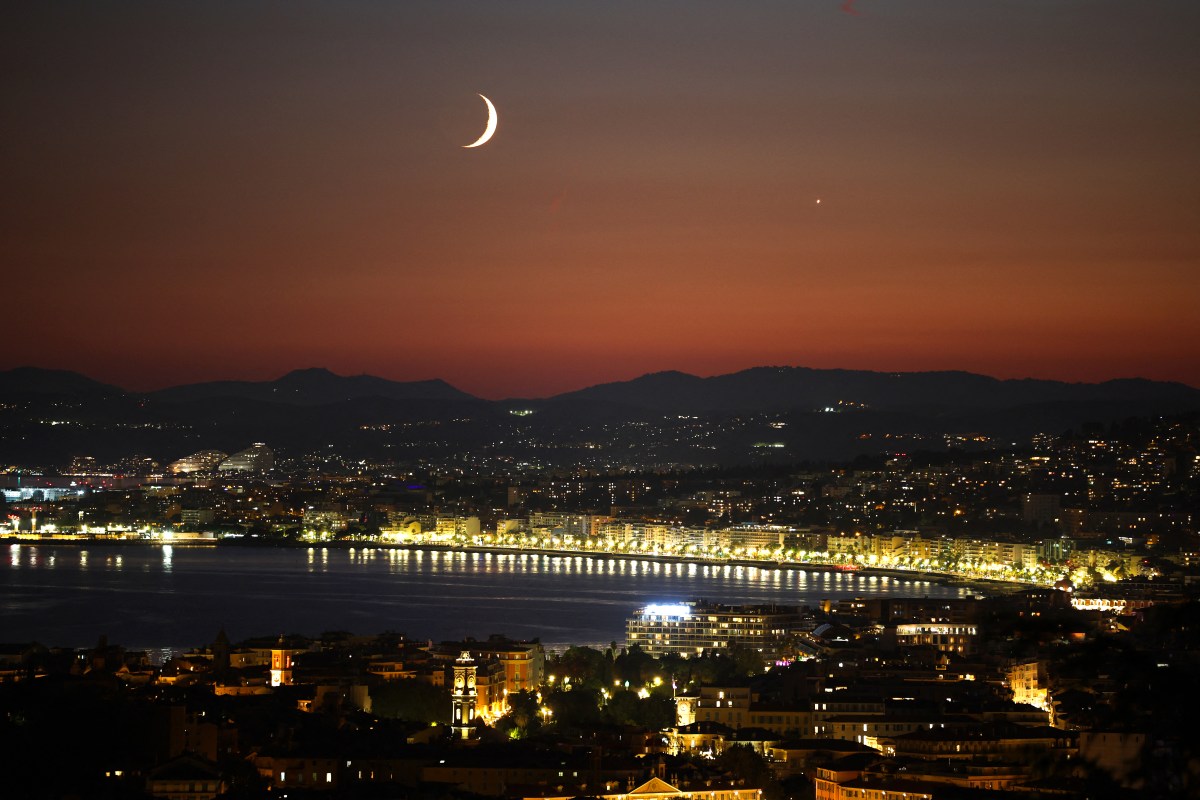
Sky watchers across the country have an opportunity to see Venus “outshining every star around it,” with the planet set to reach peak brilliance on Friday. The display is just one of many celestial events scheduled for the remainder of the month, according to NASA’s September skywatching guide—among them the equinox and the emergence of the Harvest Moon alongside Neptune and Saturn. NASA says September 18 is when Venus will reach peak brilliance.
EarthSky puts the event’s precise peak at around 11 p.m. According to the publication, it will shine at a magnitude of -4.8, which it said was “much, much brighter than any star.” In astronomy, apparent magnitude measures a celestial object’s degree of brightness as it appears from Earth. The scale runs in reverse, meaning that lower numbers indicate brighter objects.
NASA advises those hoping to witness the event to look west shortly after sunset, where the planet will “stand out as a brilliant point of light above the western horizon, outshining every star around it.” The agency adds that a clear view of the horizon offers the best chance to catch Venus before it sets. Venus is the second planet from the Sun. NASA says the planet also has a comparable size and structure to Earth and is the third-brightest object in the sky, after the Sun and Moon.
"Venus peaks in brightness when it is ending its evening visibility or starting its morning one," astronomer Gianluca Masi previously told Newsweek. "Because Venus' orbit is entirely inside that of the Earth, we see it only for some time after sunset or before sunrise." According to NASA, the next full moon will occur on September 26. It said the Harvest Moon will rise in the east shortly after sunset.
The term “Harvest Moon” has agricultural origins, and refers to a time when farmers would depend on its bright light to extend the workday after sunset, helping them to gather ripening crops, as explained by NASA. The agency added that this year’s Harvest Moon will be flanked by Neptune and Saturn, which it said will appear in a “wide triangle” in the sky. While the agency said Saturn would be visible with the unaided eye, Neptune, at around magnitude 8, would require binoculars or a telescope to be seen.
NASA said Venus will be in the west after sunset on September 18, while the Harvest Moon is set to rise in the east later in the month, on September 26. For local conditions, viewers could consult the National Weather Service’s sky-cover forecasts. NASA’s September skywatching guide also highlighted the September equinox on September 22, when fall officially begins in the Northern Hemisphere while the Southern Hemisphere welcomes spring.
Extract — continue reading at the source.