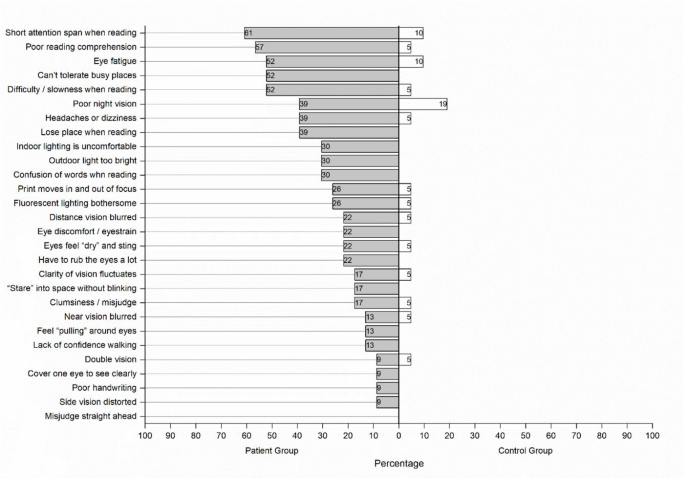
After a SARS-CoV-2 infection, neurological manifestations may persist as part of long COVID/post COVID-19 condition (PCC). The pathophysiological mechanisms remain incompletely understood. This study therefore aimed to investigate visual symptoms, visual and neuroretinal status, and their associations with fatigue and cognitive performance in individuals with PCC.
Twenty-three individuals with PCC and nineteen matched controls underwent standardized assessments of visual symptoms and function, neuroretinal structure using optical coherence tomography (OCT), and cognition using a neuropsychological test battery. The PCC group reported higher levels of visual symptoms, general fatigue, and mental fatigue. Visual function was largely preserved, although symptomatic individuals demonstrated reduced performance on vergence facility and developmental eye movement tests.
No significant group differences were found in retinal nerve fibre layer (RNFL) or ganglion cell layer (GCL) thickness; however, disrupted correlations between RNFL and GCL were observed in the PCC group. In PCC, lower RNFL was associated with worse executive function (Stroop color-word test) and vergence facility. The findings suggest a dissociation between subjective visual complaints and objective dysfunction, with convergence facility emerging as a potentially sensitive marker.
Altered structure-function relationships in OCT metrics may reflect subtle neuroretinal involvement. Visual symptoms and fatigue were prominent in PCC. While overt neuroretinal thinning was not observed, altered correlations and associations with cognitive function underscore the need for further research into neuro-visual mechanisms in post-COVID sequelae.
Neurological manifestations constitute a substantial component of the diverse symptomatology associated with COVID-19. Longitudinal studies indicate that up to one-third of affected individuals experience persistent neurological sequelae, including fatigue, cognitive impairment, headache, sensory disturbances, and dysautonomia for at least 12 months following infection1. These symptoms may persist as part of a prolonged post-infectious syndrome, formally recognized as post-COVID condition (PCC)2.
The mechanisms behind the neurologic manifestations are not fully understood, however several hypotheses have been proposed, including neuroinflammatory responses, endothelial dysfunction, dysimmune responses, and metabolic imbalances1,3. Potential effects on the brain have been described in terms of altered morphology and connectivity, accompanied by impairments in cognitive function4,5,6,7. Assessments of cognitive function have identified deficits in memory, attention, executive function, and processing speed4,8,9,10.
Extract — continue reading at the source.


