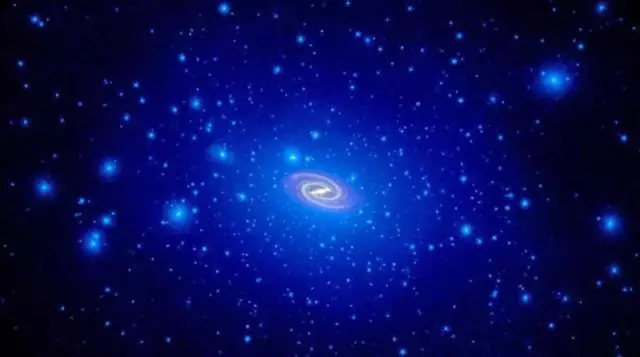
It’s hard to believe, but the idea that the Universe was dominated not by normal matterbut rather by dark matter — a novel form of non-interacting matter that’s completely distinct from protons, neutrons, and electrons — goes all the way back to 1933: nearly a full century ago. For decades, the overwhelming majority of the leading astronomers and physicists dismissed the idea as being ill-motivated and lacking sufficient evidence backing it, and it gained very little traction on both the theoretical and observational fronts throughout the 1930s, 1940s, 1950s, and 1960s. It was only with the novel results and improved instrumentation initially leveraged by Vera Rubin and Kent Ford, and then further developed by Rubin on her own, that dark matter was brought into the cosmological mainstream in 1969 and then throughout the 1970s.
So who should get the credit for discovering dark matter? Did either Fritz Zwicky, who first presented that initial 1933 evidence and even coined the term _dunkle materie_, which directly translates to dark matter, or Vera Rubin, with her pioneering work concerning galactic rotation in the 1970s, actually discover dark matter? Could either of them be credited with at least presenting the overwhelming evidence in favor of dark matter’s existence?
Or is it unfair to say that dark matter was actually discovered by either of them, including up through and including the present day? Although the astronomical evidence is overwhelming for dark matter’s existence, attributing dark matter’s “discovery” to any one individual misses the entire point of science, including how it’s conducted and how conclusions are reached. Here’s a context-rich history of dark matter that might surprise you in many ways.
The Hooker Telescope: the largest and most powerful telescope in the world from 1917–1949. This telescope was 100 inches (2.54 meters) in diameter, making it larger than the primary mirror on the Hubble Space Telescope today. It held the crown for largest telescope in the world until the Hale telescope, double the diameter of this one, was finally completed in 1949, 21 years after work was begun on it.
This was the one telescope, more than any other, that was the key to unlocking the expanding Universe. By the time the 1930s came along, even though that was already a full 93 years ago, astronomy was actually quite advanced as a science. It was with this picture of the cosmos that the first hints of dark matter were discovered.
In 1933, Fritz Zwicky was studying the galaxies in theComa Cluster: a cluster of galaxies located just ~300 million light-years away. With over 1,000 identified galaxies in it today, it’s larger, richer, and more regular than the nearbyVirgo Cluster(itself only ~50–60 million light-years away), and many of its galaxies are large, bright, and luminous. The Coma Cluster of galaxies, as seen with a composite of modern space and ground-based telescopes.
Extract — continue reading at the source.