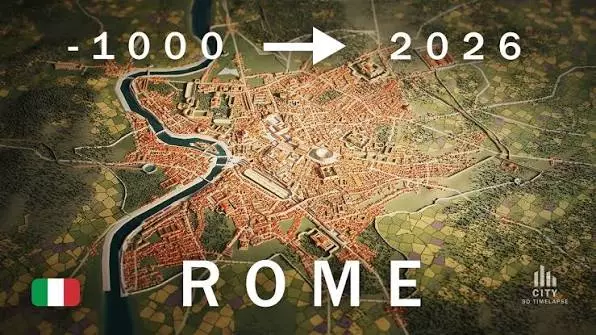
But if you watch the new video from City 3D Timelapse above, you’ll understand the lack of debate on the question of whether it fell. Around the turn of the sixth century AD, buildings start vanishing at a rate that soon turns alarming; long before the end of the first millennium, it’s clear that Rome has been plunged into very hard times indeed. In the video’s accelerated visual history, that much-scrutinized 500-year span passes in a little more than five seconds.
Just one minute later, it has spread not just beyond the old city limits, but beyond the very frame of the aerial view, becoming the vast urbanized region we know today. Legend has it that Rome was founded in 753 BC, when Romulus killed his twin brother Remus. As reflected by the video, archaeological evidence suggests that the area was settled earlier, though the traditional date of Rome’s founding roughly coincides with the emergence of what we know as the Roman Kingdom.
There follow the Roman Republic, the Roman Empire, the medieval era — when the once-formidable Eternal City was left practically for dead — the Renaissance, the Roman Baroque period, the industrial era, and finally, our time of globalization. For reference, the classical archaeologist Giovanni Piranesi went to Rome and drew his influential etchings of its ruins around the 1:55 mark of this three-minute video. Not that the Rome captured in Piranesi’s Vedute bears much resemblance to the Rome of the twenty-first century, for better or for worse.
You can still see the Colosseum by moonlight, but the ambience won’t be the same: the overgrowth has long since been scraped off, and the cargo shorts are out in force year-round. Regardless, no city is best appreciated through its landmarks alone, not even the modern Rome so long both celebrated and dismissed as an open-air museum. Watching it rise, fall, and rise again from above within the length of a Eurovision song reminds us that it wasn’t built, or rebuilt, in a day — and that, in the face of often-formidable difficulties, it even now manages to put up something new once in a while.
How Rome Began: The History As Told by Ancient Historians A Virtual Tour of Ancient Rome, Circa 320 CE: Explore Stunning Recreations of The Forum, Colosseum and Other Monuments The Changing Landscape of Ancient Rome: A Free Online Course from Sapienza University of Rome What Did Ancient Rome Look Like? A 3D Virtual Tour of the City During the Second Century AD Timelapse Animation Lets You See the Rise of Cities Across the Globe, from 3700 BC to 2000 AD A 3D Animation Shows the Evolution of New York City (1524 — 2023) When the Colosseum in Rome Became the Home of Hundreds of Exotic Plant Species Based in Seoul, Colin Marshall writes and broadcasts on cities, language, and culture. He’s the author of the newsletter Books on Cities as well as the books 한국 요약 금지 (No Summarizing Korea) and Korean Newtro.
Follow him on the social network formerly known as Twitter at @colinmarshall. by Colin Marshall | Permalink | Comments (0) | We’re hoping to rely on our loyal readers rather than erratic ads. To support Open Culture’s educational mission, please consider making a donation. We accept PayPal, Venmo (@openculture), Patreon and Crypto!
Extract — continue reading at the source.