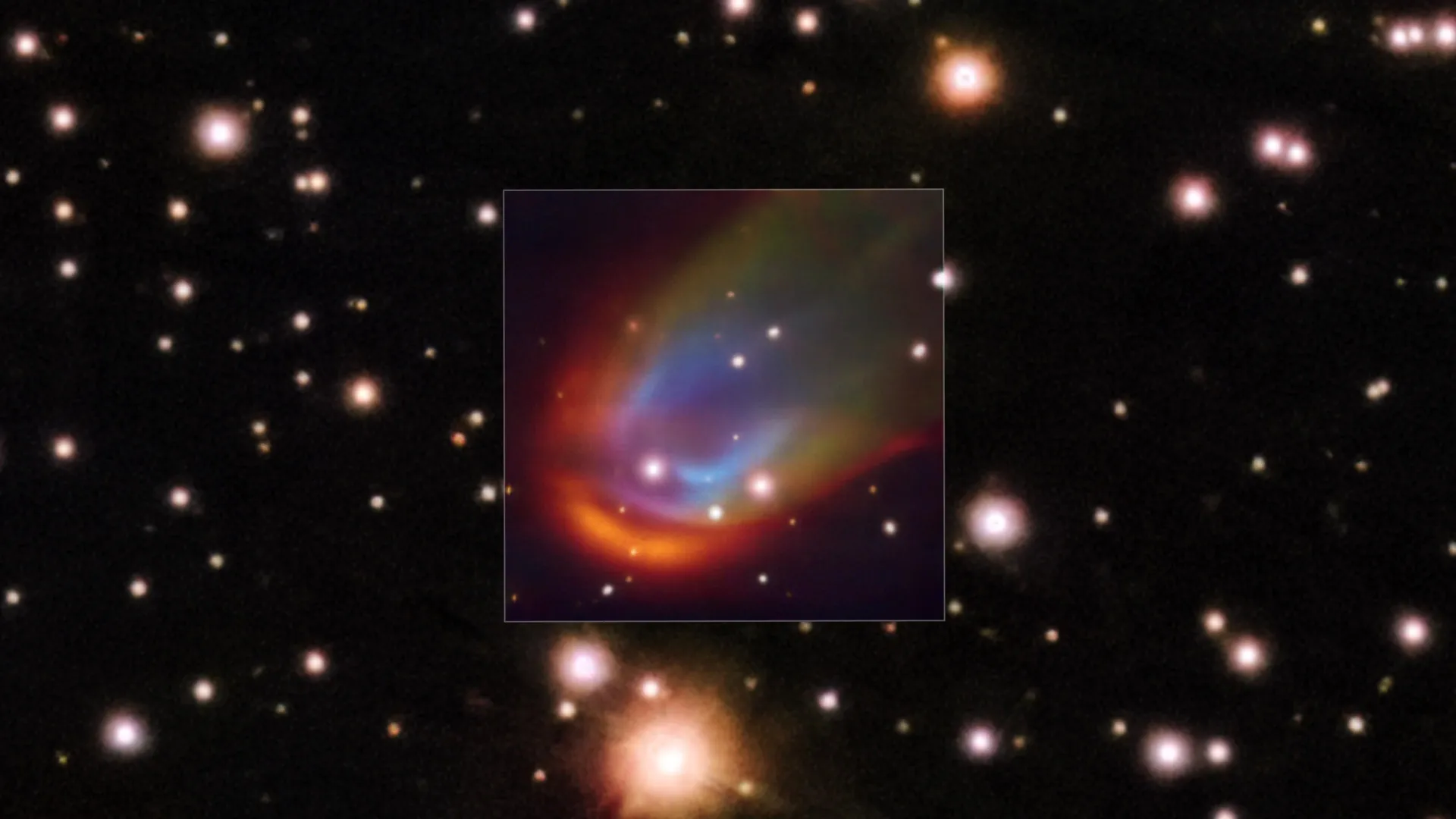
Stars can produce powerful shock waves when gas and dust streaming away from them collide with material in the surrounding space. Astronomers have now captured a striking example around the dead star RXJ0528+2838 using the European Southern Observatory's Very Large Telescope (ESO's VLT). The discovery is puzzling because, based on known mechanisms, this small stellar remnant should not be capable of producing the structure seen around it.
The unexpected finding challenges current ideas about how dead stars exchange matter and energy with their surroundings. "We found something never seen before and, more importantly, entirely unexpected," says Simone Scaringi, associate professor at Durham University, UK and co-lead author of the study published in Nature Astronomy. "Our observations reveal a powerful outflow that, according to our current understanding, shouldn't be there," says Krystian Ilkiewicz, a postdoctoral researcher at the Nicolaus Copernicus Astronomical Center in Warsaw, Poland and study co-lead.
Astronomers use the term 'outflow' to describe material expelled from an object in space. RXJ0528+2838 lies about 730 light-years from Earth. Like the Sun and other stars, it travels around the center of the Milky Way.
As it moves through space, it encounters gas between the stars, producing a type of shock wave known as a bow shock. Noel Castro Segura, research fellow at the University of Warwick in the UK and collaborator in this study, describes it as "a curved arc of material, similar to the wave that builds up in front of a ship." Bow shocks are typically produced when material flowing away from a star slams into its surroundings. In the case of RXJ0528+2838, however, astronomers cannot identify any known process that fully accounts for what they observed.
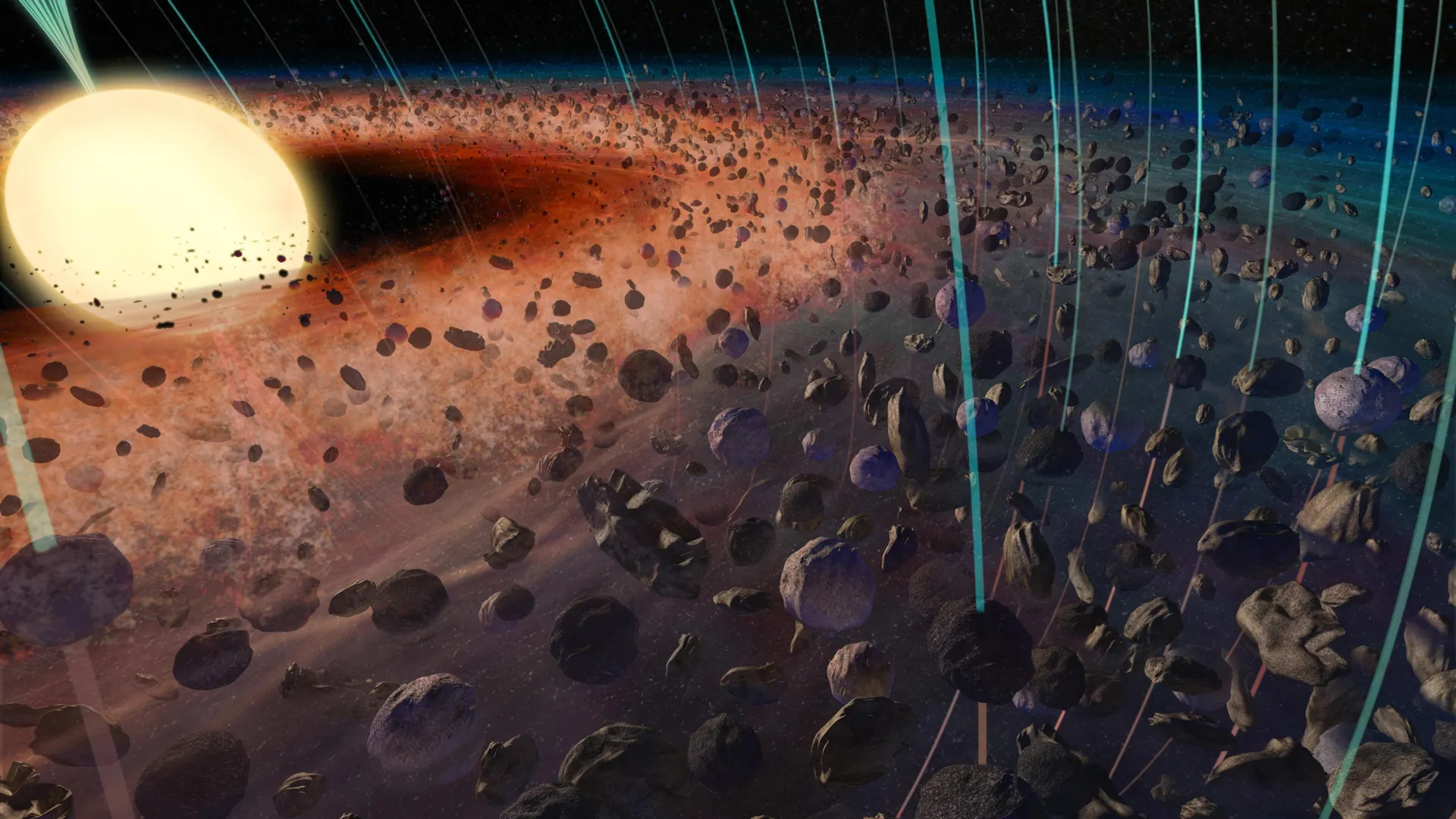
RXJ0528+2838 is a white dwarf, the leftover core of a dying low-mass star, and it is orbited by a Sun-like companion. In binary systems like this one, material can be pulled away from the companion and transferred onto the white dwarf. That material often forms a disc around the dead star.
The disc feeds the white dwarf, while some matter can also be thrown back into space in powerful outflows. RXJ0528+2838 is different. Astronomers see no evidence of such a disc, leaving them without the usual explanation for the outflow and the surrounding nebula.
Extract — continue reading at the source.