Since NASA's James Webb Space Telescope first revealed little red dots (LRDs) in 2022, astronomers have been trying to determine exactly what these strange objects are. The compact, extremely distant red sources appear throughout the early universe, but their true nature has remained difficult to explain. One leading idea is that little red dots are supermassive black holes known as active galactic nuclei.
However, they do not behave quite like the active galactic nuclei astronomers observe in the nearby universe. LRDs are common at high redshift, but their numbers fall sharply at lower redshifts. (The higher the redshift, the greater the distance the light has traveled across the universe.) That difference has raised an important question: What happens to these mysterious objects as the universe grows older? A Possible Evolutionary Path for Little Red Dots A research team led by Pierluigi Rinaldi of the University of Arizona's Steward Observatory, who is now at the Space Telescope Science Institute (STScI) in Baltimore, may have found part of the answer.
Building on earlier research, the team published a new study on July 29 in The Astrophysical Journal. Their results suggest that little red dots may not represent an entirely separate population of galaxies. Instead, their unusual appearance could partly result from observational bias.
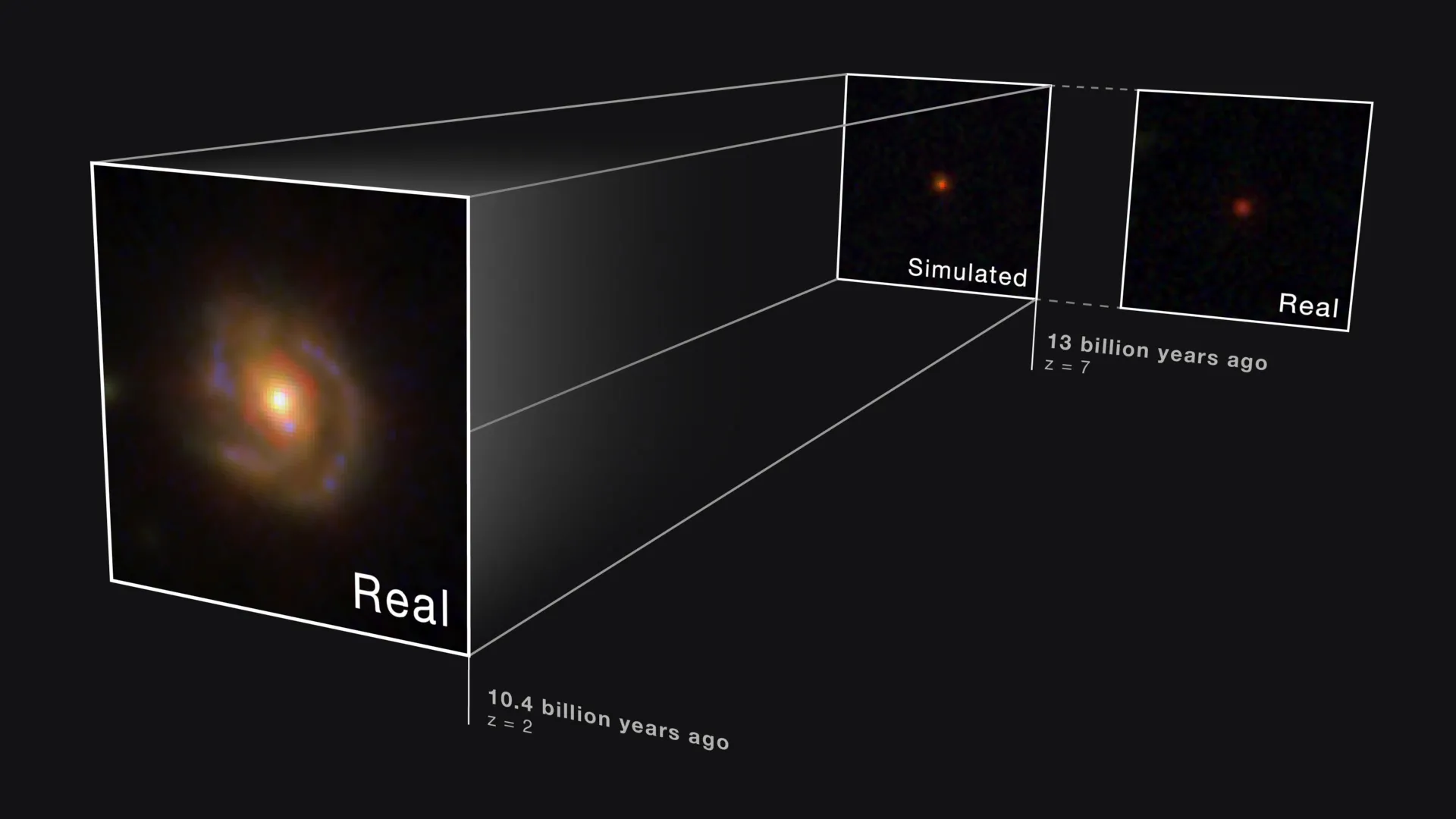
At extreme distances, some surrounding structures become too faint for current telescopes to detect, leaving only the bright central source visible. The researchers reached this conclusion by studying a lower-redshift spiral galaxy called WISEA J123635.56+621424.2. They nicknamed it the "Saguaro" because its prominent spiral arms resemble the cactus found in the Sonoran Desert of the Southwestern United States.
The galaxy sits at redshift 2, meaning astronomers see it as it appeared roughly 3.3 billion years after the Big Bang. At its center is a compact red source that closely resembles a little red dot and even evokes the ruby red fruit of the desert cactus. "Everything created in the early universe must evolve into something around us.
We have had little idea of what LRDs become, but these results finally show us how to find their progeny," said co-author George Rieke of the University of Arizona. Earlier observations from NASA's retired Spitzer Space Telescope had already provided an early glimpse of the dust-obscured, compact galaxy population in the lower-redshift universe that includes the Saguaro. Those findings helped set the stage for more detailed observations with NASA's Hubble and James Webb space telescopes.
Extract — continue reading at the source.