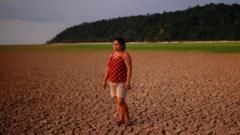
A natural weather pattern called El Niño - which could bring extreme weather to many parts of the world - has begun, US scientists say. The National Oceanic and Atmospheric Administration (NOAA) said that El Niño conditions are likely to strengthen over the rest of 2026. Many forecasts suggest it could be one of the strongest El Niños ever recorded.
Coming on top of decades of human-caused warming, 2027 may be the hottest year on record, with disruption to weather, food supplies and economies. An El Niño develops in the Pacific Ocean and the atmosphere above it. When the winds that typically blow east-to-west weaken or reverse, warmer water can spread across the central and eastern tropical Pacific.
Scientists at NOAA announced that a new El Niño phase had started after observing sea surface temperatures more than 0.5C above average in the central tropical Pacific. They also noticed a switch in atmospheric conditions, with a drop in pressure over the central Pacific compared with the western Pacific. The Japanese Meteorological Agency also said that El Niño conditions are present.
Some scientists have warned that this El Niño could be especially strong, partly because the water beneath the surface of the Pacific is unusually warm. These waters have been about 6C above average in places, according to the UN's World Meteorological Organization. Deep-sea heat is often followed by warmer waters at the surface.
A "very strong" or so-called "super" El Niño is when the warming of the central tropical Pacific Ocean surface reaches 2C or more over an extended period. These events have only happened a few times since 1950. The NOAA said there was a 63% chance of this El Niño ending up "very strong".
That would "rank among the largest El Niño events in the historical record going back to 1950", it added. It is expected to last at least into early 2027. The El Niño phenomenon was first observed by Peruvian fishermen in the 1600s, who nicknamed it El Niño de Navidad - Christ Child in Spanish.
Extract — continue reading at the source.


