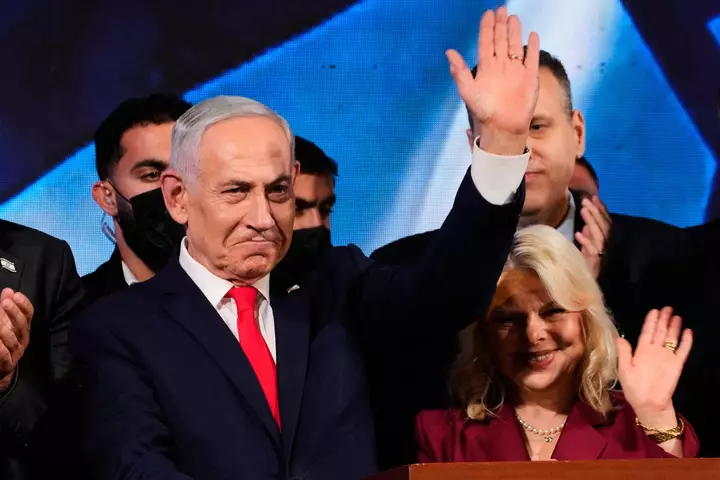
With no declared winner in what many Israelis see as the most important election in the country's history, current Prime Minister Benjamin Netanyahu remains in power for now, with his political future hanging in the balance. Experts detailed four possible outcomes to Newsweek. With 85 percent of votes counted, the pro-Netanyahu camp has secured 53 seats, while parties aligned with main challenger Gadi Eisenkot have won 48 seats, according to Israeli election officials.
A majority in the Israeli parliament, the Knesset, requires at least 61 seats. Israeli Arab parties won 19 seats, which Israeli media described as a "historic" high and that put them in a potentially decisive position in coalition talks. Tuesday's election recorded the highest voter turnout in decades, and was widely seen as a judgment on Netanyahu's stewardship of the Israeli war in Gaza following the October 7 attacks in 2023, the U.S.-led war with Iran, Israel's relationship with the U.S. and the country's increasing isolation from the rest of the world.
Ahead of the vote, observers suggested the race would be a knife-edge contest between Netanyahu's right-wing and ultra-Orthodox bloc and those siding with former military chief Eisenkot. Both Netanyahu and Eisenkot said they would try to form a government, which could mean weeks of maneuvering, with the incumbent remaining in power as caretaker leader until a new government coalesces. While opposition politicians heralded the exit polls as a resounding defeat for Netanyahu, some analysts caution that the prime minister, who has spent nearly two decades in power, has a history of surviving apparently career-ending crises.
With experts divided on the most likely next steps, what are the potential options for those vying for power in Israel now? Israel's president, Isaac Herzog, called on all parties to do "everything" to avoid another election and approach coalition negotiations "with an open mind." Herzog oversees the power jockeying, nominating one candidate to form a government. This chosen candidate has up to 42 days to cobble together a ruling coalition.
Herzog is likely to push Netanyahu to make Eisenkot an offer to build a coalition, but the "odds are strongly against this," said Ezra Hess, a research associate for Middle Eastern studies with the Council on Foreign Relations. A second round of parliamentary elections would be triggered by the rounds of coalition talks failing. It would follow much the same pattern as Tuesday's vote, but it's not clear how the candidates would change their stances in an attempt to gain enough votes to form a government.
A fresh vote is the most probable scenario, Yaakov Katz, the former editor-in-chief of The Jerusalem Post newspaper, told Newsweek. This would mean "nobody budges, nobody breaks a promise, and neither bloc assembles 61 seats," he said. But if Netanyahu's bloc gets closer to clinching half of the Knesset's 120 seats, he could look for "individual defectors" to join him, said Katz.
Extract — continue reading at the source.