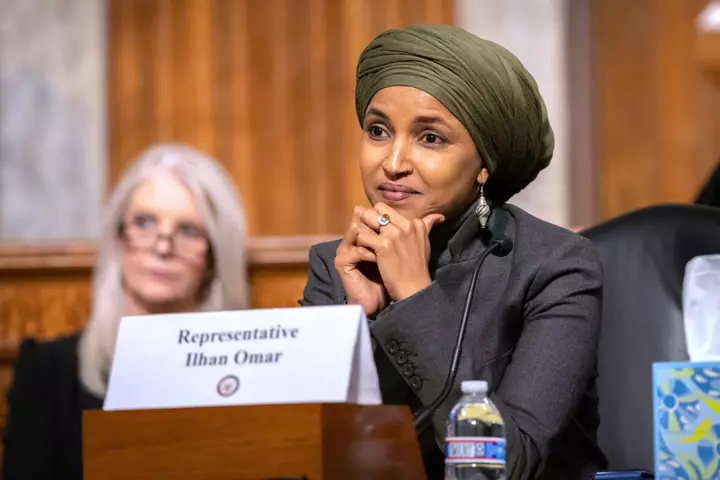
Representative Ilhan Omar's account of fleeing Somalia's civil war as a child offers a timeline of her early life, family history and eventual resettlement in the United States, including a recollection of how officials recorded relatives' birth dates during the refugee screening process. The Minnesota Democrat's 2020 memoir, This Is What America Looks Like: My Journey From Refugee to Congresswoman, describes a childhood disrupted by fighting in Mogadishu and a journey that took the family through Somalia and Kenya before they were eventually resettled in the United States. Omar has faced a wave of scrutiny from MAGA hard-liners and conservative critics over longstanding, unproven allegations concerning her former husband, Ahmed Nur Said Elmi.
Omar has repeatedly denied that Elmi is her brother or that their marriage was fraudulent. Federal agents searched Omar's Washington home on October 12, and investigators obtained a DNA sample, a source close to the matter previously told Newsweek. Omar's sister, Sahra Noor, also voluntarily spoke with investigators, according to the source.
No court has found Omar committed immigration fraud. The memoir mentions Ahmed Abdisalan Hirsi, Omar's first husband, several times, but Elmi, whom Omar legally married in 2009, is not mentioned in Chapter 11, which covers 2009 to 2011. Omar has repeatedly rejected allegations about Elmi.
In 2019, The Daily Beast reported the claim could be traced to an anonymous 2016 post on the Somali diaspora forum Somali Spot that provided no evidence and was written by a user the outlet said had a history of trolling. In her memoir, Omar says the scrutiny prompted her to issue a statement explaining her civil and religious marriages and separations. She says in her memoir she later regretted responding and describes the immigration fraud allegation, repeated by President Donald Trump in 2019, as a “baseless conspiracy theory.” National Review senior political correspondent Jim Geraghty questioned Omar's birth date in a post on X, pointing to a chapter of her memoir headed "War: 1989-1991, Mogadishu, Somalia." Omar writes: "I was eight years old when civil war broke out in Somalia." Geraghty cited the July 1989 Mogadishu riots and argued that if Omar was eight at that point, she would have been born in 1981 rather than 1982.
However, later in the same chapter, Omar describes 1992 as "the year after the war began," placing the war's beginning in 1991. That is consistent with her publicly listed birth date of October 4, 1982, which meant she was eight for most of 1991. "Representative Omar and her family fled Somalia’s civil war when she was eight," a section about Omar reads.
"She spent four years in a refugee camp in Kenya before emigrating to the United States." The exact start of Somalia's civil war is not straightforward. The U.N.'s history of the conflict says Siad Barre fell in January 1991, while MSF's account describes Somalia as being in civil war by December 1990. The July 1989 riots occurred earlier, but the memoir does not say those riots were what Omar meant when she wrote that she was 8 when civil war broke out.
Extract — continue reading at the source.