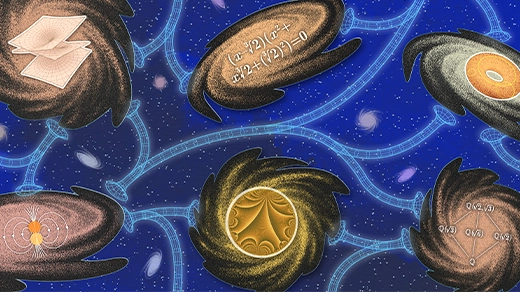
The mathematical universe is boundless and heterogeneous, encompassing, over here, truths about numbers and equations; there, the logic of shapes and spaces; and over there, the study of change and probability. Its domains have grown organically over centuries, each centered around its own objects, methods, and questions. That’s why it’s so surprising when direct connections between different areas of math are discovered, like wormholes linking distant galaxies.
The wormholes are known as Langlands correspondences, and the decades-long effort by hundreds of mathematicians to extend and exploit these correspondences is the Langlands program. Because it suggests an underlying unity to the universe of mathematical truths, the Langlands program has been called a “grand unified theory of mathematics.” Yet even most mathematicians don’t quite know what to make of it. I asked several experts connected to the Langlands program whether they thought the average attendee at the recent International Congress of Mathematicians would have a decent understanding of what it is, or if they would have no idea.
One said it’s all about “unexpected symmetries.” Another defined it as “bridges between two areas of mathematics.” Someone else said it’s “the best vision we have to understand non-abelian versions of Fourier theory” — a statement I’ll unpack later, because it might be the deepest explanation available so far. References were made to the parable of the blind men and the elephant. The program has so many aspects and corners and consequences that it can be hard to interpret.
Mathematicians shy away from interpretation by nature, anyway, since anything they say will be unproven. Another challenge is that though the Langlands program is sweeping and unifying, the mathematical correspondences themselves are excruciatingly specific and esoteric. Here is my attempt, as someone who has covered math and physics for years, to unpack Langlands from its origins to its current form as a mathematical project with no precedent.
I’ll also explore what this set of connections means. It’s not easy, because mathematicians have yet to mine the deepest meaning of the Langlands program — an obscure message that seemingly pertains not only to the mathematical universe, but also to the physical one. Robert Langlands, a Canadian mathematician now in his 80s who occupies Albert Einstein’s former office at the Institute for Advanced Study in Princeton, New Jersey, launched the program that bears his name in 1967.
In a letter to a colleague, he picked up on a connection between far-flung mathematical realms: number theory and harmonic analysis (the study of signals and waves). From there, Langlands conjectured the existence of a family of correspondences between objects, symmetries, and properties. To understand that original Langlands wormhole, we can start with a collection of numbers called $latex \mathbb$.
Extract — continue reading at the source.
/https://tf-cmsv2-smithsonianmag-media.s3.amazonaws.com/filer_public/59/49/59497682-9b3c-4ff7-9d94-c78d21f661cc/gettyimages-2201698070.jpg)

/https://tf-cmsv2-smithsonianmag-media.s3.amazonaws.com/filer_public/9c/ec/9cecf0eb-f893-42d3-a0fd-739da0636b1e/https___wwwfrontiersinorg_files_articles_1762680_xml-images_focsu-04-1762680-g0008.webp)
/https://tf-cmsv2-smithsonianmag-media.s3.amazonaws.com/filer_public/eb/84/eb843981-bc89-40b9-a3bb-384c8e813db7/uprising.png)