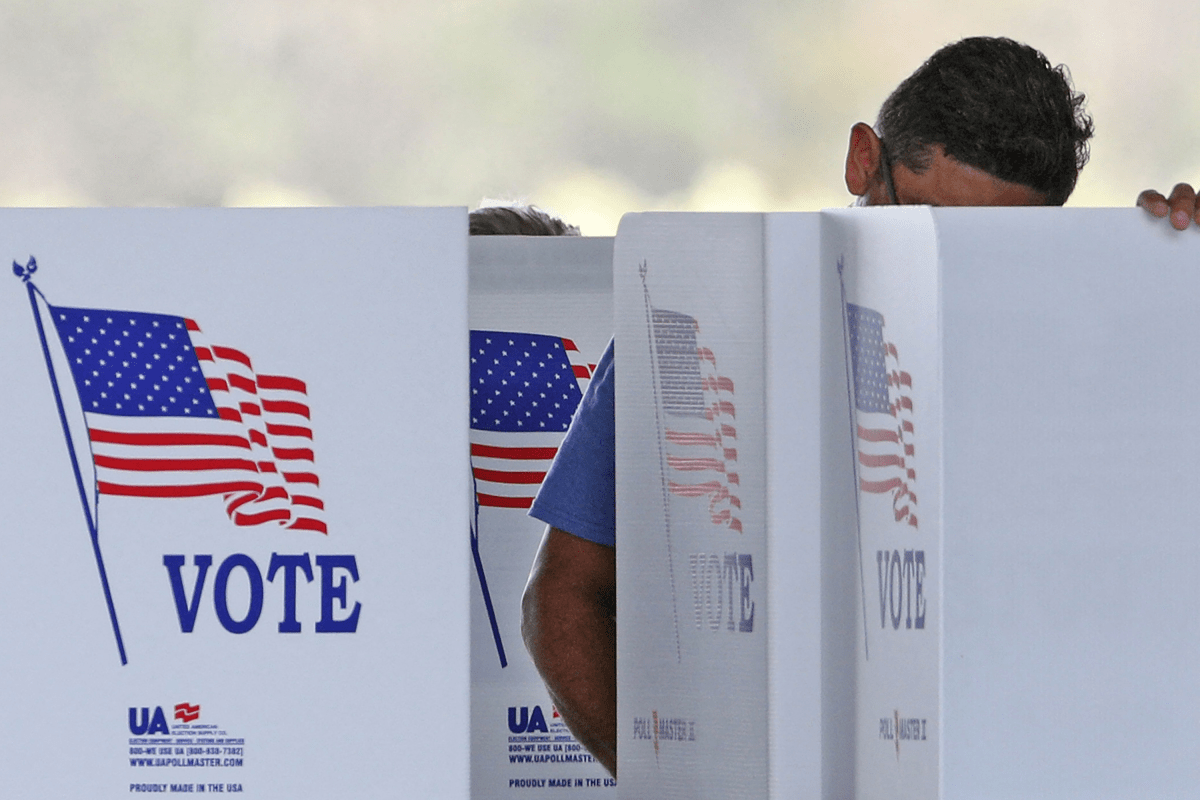
Midterm polling two months before Election Day is producing a clearer, but far from conclusive, picture of the battle for Congress. Democrats have the stronger national environment and the more obvious path to the House of Representatives, while control of the Senate could turn on six races that nonpartisan analysts continue to rate as toss-ups. An Emerson College national poll released August 20 gave Democrats an eight-point advantage on the congressional ballot, with 51 percent supporting the Democratic candidate and 43 percent backing the Republican.
Six percent were undecided. Prediction markets pointed to the same split between the two chambers at the time of writing. Polymarket priced Democrats at 89 percent to win the House and Republicans at 12 percent, with nearly $10 million traded in the market.
Its Senate market was effectively even, showing Democrats at 51 percent and Republicans at 50 percent, with just over $4 million traded. Kalshi leaned the other way in the Senate, pricing Republicans at 51 percent and Democrats at 49 percent, on more than $11 million in trading. Kalshi’s balance-of-power market gave an 86 percent combined chance to outcomes involving a Democratic House, including a 47 percent chance of Democrats controlling both chambers and a 39 percent chance of a Democratic House paired with a Republican Senate.
The figures may not add precisely to 100 because they are displayed market prices, rather than a single normalized polling estimate. Prediction markets can quickly absorb polling, campaign developments and other information because traders have money at risk, producing continuously updated estimates of an outcome’s likelihood. However, they reflect traders’ expectations rather than a representative sample of voters, and their prices can be affected by participation, liquidity and each contract’s rules.
They are therefore best read alongside polls, nonpartisan ratings and statistical forecasts, rather than as evidence of how voters intend to cast their ballots. Meanwhile, a new /Ipsos poll completed August 31 found President Donald Trump’s approval rating at 33 percent for a third consecutive survey. Democratic voters also reported greater enthusiasm about November than Republicans, 46 percent to 31 percent, while independents preferred Democrats on the congressional ballot by 36 percent to 22 percent.
The survey of 1,167 adults had a margin of error of 3 percentage points. The Democratic advantage is also reflected in at least one current election model. Decision Desk HQ’s forecast, updated September 1, gave Democrats a 67 percent probability of winning the House and Republicans a 33 percent probability.
Extract — continue reading at the source.