Here on planet Earth, we normally think of our own home world as round, and yet it’s anything but a perfect sphere. If it were made of a perfect fluid, didn’t rotate, and were completely isolated from other masses that exert tidal forces on it (like the Sun and the Moon), it would be theoretically be massive enough to pull itself into a perfectly spherical shape, but that doesn’t line up with physical reality. The Earth instead is made of non-uniform material, has several interior layers that subduct and uplift, and is flattened into an oblate spheroidal shape: compressed at the poles and bulging at the equator.
All told, the peak of Chimborazo in Ecuador is farthest from Earth’s center at 6384.4 kilometers, while the geographic North Pole in the Arctic Ocean is closest point on the atmospheric surface at just 6356.77 kilometers away. All told, that means that Earth is “only” a sphere to a precision of 99.57%, with an 0.43% departure from perfect sphericity. Lower mass worlds, like moons, dwarf planets, asteroids and Kuiper belt objects, have even higher mountains and deeper craters on them relative to their world’s size, whereas the highest-mass planets in our Solar System, Jupiter and Saturn, rotate so quickly that their equatorial and polar radii differ by between 7-10%: much greater than Earth’s.
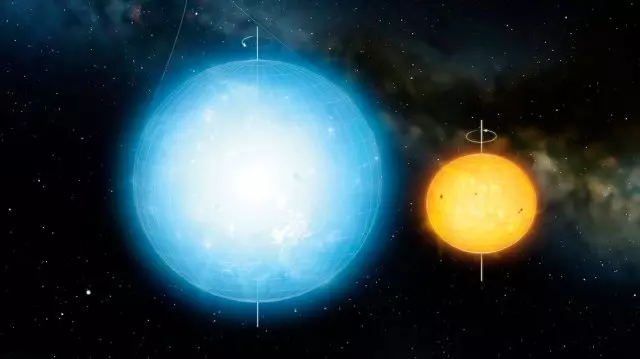
But the Universe is vast and varied, with objects much more massive — and hence, with much more gravity — than any planetary objects we know of. Which ones, among them all, are the closest to being a perfect sphere? The competition is presently between the slowest-rotating massive stars and the slowest-rotating neutron stars, with the ultimate winner having yet to be determined.
Here’s what we know today. This image of the Sun, taken on April 20, 2015, shows a number of features common to all stars: magnetic loops, prominences, plasma filaments, and regions of higher and lower temperatures. However, the slowly-rotating Sun is the most perfect sphere in the Solar System, with a polar and equatorial diameter that are identical to 99.9993% precision.
First, before we look out into the deep Universe, there are two examples from the Solar System that are the “most spherical” of anything we’ve ever known of firsthand. The first is a natural example: the roundest natural object in the Solar System happens to be the Sun. It’s all three of: All told, the Sun’s equatorial radius is only about 5 kilometers greater than its polar radius; compared to its average radius of around 696,000 kilometers, that means it’s a perfect sphere to 99.9993% precision, with only a 0.0007% deviation. (Venus is the roundest among the planets, but its high-peaked mountains deviate from perfect sphericity by 0.18%.) In the laboratory, however, we’ve beaten the roundness of the Sun ever so slightly: by constructing the incredible niobium-coated quartz spheres that were built for the Gravity Probe B mission to precisely test Einstein’s General Relativity.
These 1.5 inch (4 cm) diameter spheres had their surfaces polished to within 40 atoms (about 10 nanometers) of equidistance from the center point, for a perfect sphere of 99.99995% tolerance (0.00005% deviation from sphericity). This quartz sphere, on the left, and a similar sphere after being coated in niobium, right, were exquisitely manufactured and polished to be the most perfect sphere ever made in a laboratory on Earth. Just 1.5 inches (4 cm) in diameter, every point on their surfaces is no more than 40 atoms width farther from the center than any other point: a record-setting tolerance of 0.00005% percent.
Extract — continue reading at the source.