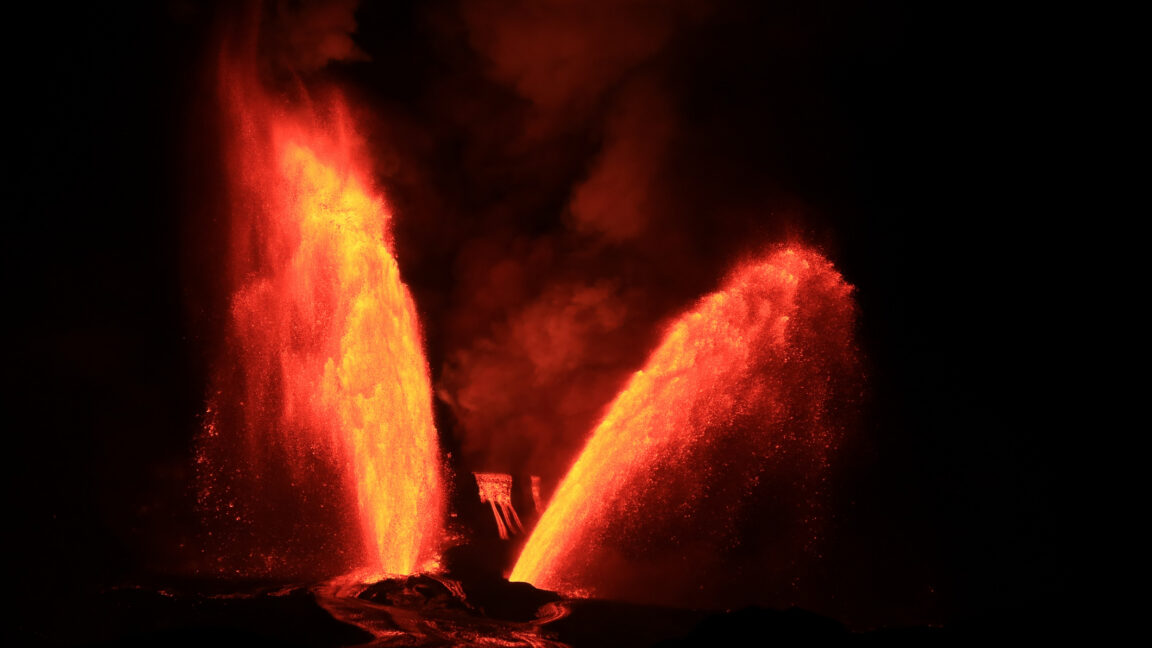
In most cases, hotspot-driven volcanism is relatively sedate, with lava flowing down mountainsides slowly enough that people can walk out of its way. But in a number of locations—Mount Etna, Hawaii, Iceland—lava gets expelled in dramatic fountains that can reach several hundred meters in height. Right now, we’re not sure what powers them.
However, thanks to a recent set of eruptions at the Kilauea volcano, we have some of the best documentation yet of erupting lava fountains. In a recent edition of Science, researchers from the US Geological Survey describe what we’ve seen and compare it with what we might expect based on our best ideas about what powers these fountains of molten rock. With three active volcanic regions that engage in fountaining, there has been a steady flow of dramatic videos of red-hot molten rock spouting from the Earth.
But Kilauea has had only three fountaining episodes since 1823, even though it’s the youngest and most active volcano in Hawaii. That activity has led to intensive study, and we have a good idea of the volcano’s structure. Previous work has identified a couple of lava residues within a few kilometers of the surface, and the volcano had 35 separate data-gathering stations set up on Kilauea, including “seismic, infrasound, geodetic, gas, and visual and thermal cameras.” Following a major eruption in 2018 that partly drained one of the underground lava reservoirs, there were indications that it was being steadily refilled.
Starting in 2019, however, the refill accelerated, and the local peak inflated at a rate of more than 22 cm a year. Then, in 2023, that doubled to 57 cm a year, and spread to a nearby caldera.
Extract — continue reading at the source.