Even though the tides are slowly turning, many video games have formulaic plots that reinforce old-school gender and heteronormative roles, often featuring a hero saving a damsel in distress from a menacing villain. Historically, Nintendo has primarily marketed its games to children, with an emphasis on the family-friendly market. In the 1990s, however, boys were singled out as the main demographic.
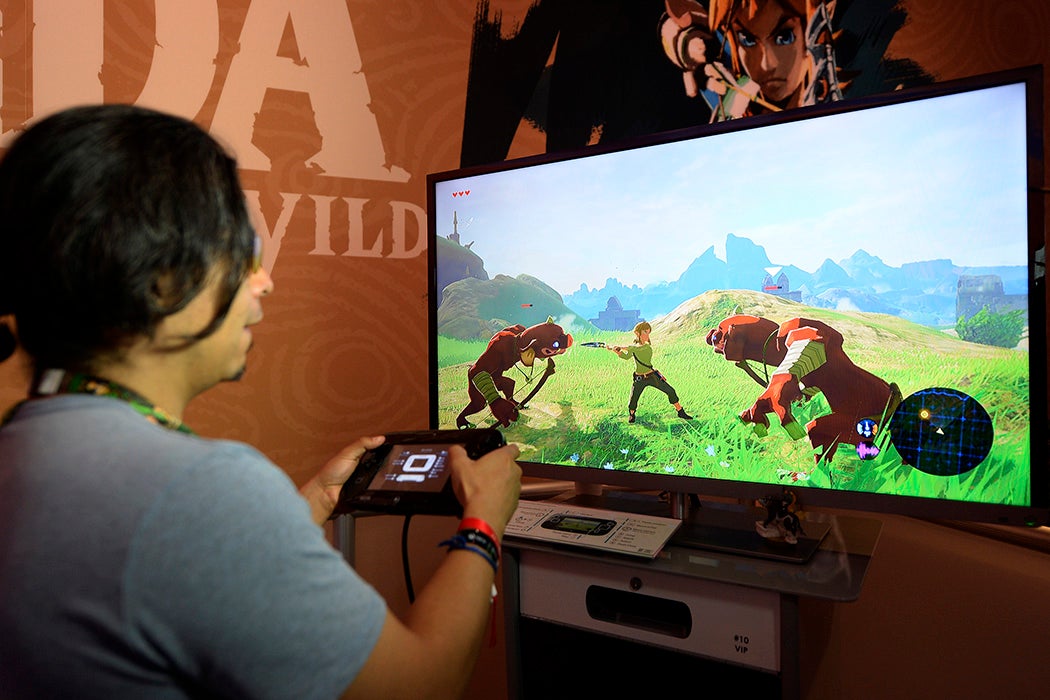
Pugh singles out The Legend of Zelda series, focusing on The Legend of Zelda (1986), The Legend of Zelda: A Link to the Past (1991), and The Legend of Zelda: Ocarina of Time (1998). That subversive potential isn’t immediately apparent. In The Legend of Zelda and The Wind Waker, for instance, he is young and elfin; in Ocarina of Time, he spends the first half of the game as a child and the second as an adult; and in Twilight Princess and Breath of the Wild, he is rendered as a young adult throughout.
Regardless of whether players and fans believe the series features one Link or multiple Links across the convoluted timeline posited in the Hyrule Historia, each of these games ends at a moment of frustrated erotic climax. On a more sexually explicit note, A Link to the Past teasingly hints at the phallic pleasures associated with Link’s weaponry. You can feel the sheer power flowing through your body!’” observes Pugh.
Later, when Link receives another sword upgrade from the Fat Fairy in the Pyramid of Power, the eroticization of the sword as a penis is made explicit: “‘Your sword is stronger! You can feel its power throbbing in your hand!’” The emphasis on Link’s style and self-presentation is also open to queer readings. More recent entries, such as Breath of the Wild and Tears of the Kingdom, offer Link an array of outfits ranging from his basic tunic to billowy, androgynous ensembles and animal-inspired attire, while earlier games also linked power-ups to costume changes.
His observation came a few years before alternate costumes became commonplace across the industry, appearing in games ranging from Mario Kart to indie productions like South of Midnight. The Legend of Zelda franchise also hints at secret alliances between Link and several of his enemies in Hyrule. Some shower him with gifts, urging him to keep the exchanges secret.
In The Legend of Zelda, piglike Moblins tell him, “It’s a secret to everybody.” In A Link to the Past, a human-animal hybrid thief tells Link, “Take some Rupees, but don’t tell anyone I gave them to you. Keep it between us, OK?” Pugh connects these exchanges to a central concern of queer theory: “Secrets—who holds, fears, or divulges them—have long stood as a hallmark hermeneutic of queer theory, for secrets about sexualities simultaneously subvert and reinforce dominant ideological constructions of purportedly deviant eroticisms.” Link’s near-total silence—he barely speaks in most games—creates further space for queer readings. Ultimately, he concludes, “essentially, one can play The Legend of Zelda and other video games queerly by looking for signs—any signs—of non-normative desire, which adds another ludic level to the game.”
Extract — continue reading at the source.
/https://tf-cmsv2-smithsonianmag-media.s3.amazonaws.com/filer_public/b1/6a/b16a91bf-2945-4bf1-be26-b0f0039c530a/0274.jpeg)

/https://tf-cmsv2-smithsonianmag-media.s3.amazonaws.com/filer_public/9e/b4/9eb46769-8da1-4938-b8ae-725c4989cf6f/psilocybin-mushrooms.jpg)