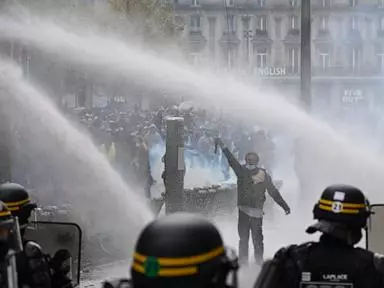
French police are under pressure to maintain security during expected protests while facing scrutiny over riot-control tactics PARIS -- Police across France are under pressure to maintain security during further protests expected in some cities, while facing scrutiny over their riot-control tactics used during previous unrest that left some teenagers seriously injured. Officers have appeared outnumbered and overwhelmed during last weekend's protests against rising living costs and poor conditions in schools. Authorities have announced police reinforcements ahead of further protests expected on Saturday, amid fears of renewed violence.
A 17-year-old girl lost an eye while participating in a protest in Mulhouse last Saturday, while a 17-year-old boy lost a hand in Saint-Etienne. Other teenagers have suffered disabling injuries during weeks of high school blockades and street demonstrations. Here’s a look at French police tactics and riot-control weapons.
French police forces are equipped with batons, tear gas, sound grenades and foam-round launchers, as well as riot shields equipped with powerful strobe lights designed to disorient protesters. Electric stun guns are prohibited in crowd-control operations. But critics, including families of injured teenagers, say the police have been too heavy-handed.
Some have called for bans on foam-round launchers, tear gas and stun grenades, echoing demands made by human rights groups since the violent 2018 “yellow vest” protests. Earlier this month, Amnesty International called for a permanent ban on all stun grenades, saying they are designed to shock, disorient and sow panic, and that some can cause permanent hearing loss and life-changing injuries from blasts and shrapnel. United Nations guidance on what it calls “less-lethal weapons” says kinetic impact projectiles should be used only against an imminent threat, targeting the abdomen and never the head, face or neck.
Firing from elevated positions or at close range, or bouncing rounds off the ground, can increase the risk of serious injury. Foam-round launchers, though classified as less-lethal and considered safer than rubber-bullet shotguns, “in certain circumstances, can kill,” said Neil Corney, an arms researcher at the U.K.-based Omega Research Foundation who helped draft the U.N. guidance. Proper training and guidelines can reduce injuries, he said, pointing to Spain, where authorities replaced criticized rubber-bullet shotguns with foam-round launchers following a violent police crackdown on Catalonia’s 2017 independence referendum.
Injuries have declined there, he said. Foam-round launchers were initially developed for military training and later adapted for “high-risk, hostage-type situations” and anti-terrorism operations, said Patrick Wilckin, an arms researcher at Amnesty International. Accountability is another concern.
Extract — continue reading at the source.