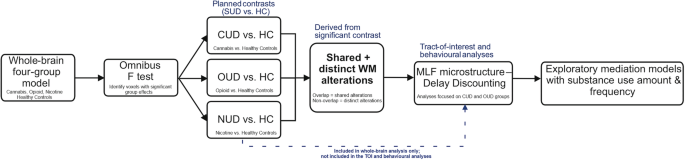
White matter (WM) microstructure is implicated in the neurobiology of substance use disorders (SUDs), yet direct comparisons across substance-dependence syndromes remain scarce. It is also unclear whether WM abnormalities relate to impulsive decision-making and substance use severity. We performed a cross-sectional, dual-centre diffusion MRI study and quantified WM microstructure using diffusion tensor imaging and neurite orientation dispersion and density imaging in 87 individuals with SUDs (48 with cannabis dependence (CUD), 16 with opioid dependence (OUD), and 23 with nicotine dependence (NUD)) and 53 nonsmoking healthy controls.
Whole-brain tract-based spatial statistics and tract-specific analyses of the middle longitudinal fasciculus (MLF), a temporo-parietal tract implicated in cognitive control and valuation, were performed. OUD and CUD exhibited convergent, widespread WM abnormalities characterised by reduced fractional anisotropy and increased mean diffusivity and orientation dispersion across fronto-temporo-parietal and limbic pathways, including the superior longitudinal fasciculus, arcuate fasciculus, cingulum, and MLF. In contrast, NUD showed more circumscribed alterations observed primarily in MD and localised mainly to anterior and callosal white matter regions.
In CUD, higher MLF orientation dispersion was associated with steeper delay discounting (r = 0.41, p = 0.011). Moderated mediation analyses indicated that this association was indirectly driven by cannabis consumption, with asignificant conditional indirect effects observed only among daily users. No significant MLF-discounting associations were observed in OUD.
Our findings reveal both shared and distinct WM alterations across SUDs and identify a link between MLF microstructure and impulsive choice in cannabis dependence. Substance use disorders (SUD) remain a major public health concern due to their strong association with poor mental health outcomes and neurocognitive impairments [1]. Individuals with SUD frequently exhibit disruptions across a range of cognitive and emotional domains, including executive functioning, emotional regulation, and reward processing [2, 3].
Recent studies suggests that different substances—such as opioids, cannabis, nicotine and alcohol—may be associated with distinct psychiatric risk profiles [4,5,6], although the overlap across mood, anxiety, and psychotic outcomes remains substantial [7]. For instance, opioid dependence (OUD) has been associated to increased risk of mood and anxiety disorders [8, 9], cannabis dependence (CUD) to heightened psychosis risk in genetically or environmentally vulnerabilities individuals [10, 11], nicotine dependence (NUD) to heightened anxiety and attentional deficits [12, 13], and alcohol to a broad spectrum of severe psychiatric and somatic outcomes [14]. Functional neuroimaging studies have consistently reported abnormalities across various SUDs [15].
These effects may show substance-related variation [16], shaped by unique pharmacokinetics, receptor profiles, and chronic exposure patterns [17]. However, despite growing evidence from functional neuroimaging, comprehensive analyses of substance-related effects on white matter (WM) and gray matter (GM) microstructural properties using structural neuroimaging techniques, such as diffusion magnetic resonance imaging (dMRI), have remained underexplored. Recent translational work has begun to address this gap, highlighting alterations in WM microstructure across both human and rodent models [18], and support for distinct microstructural patterns across substances has been provided by several meta-analyses [19, 20].
Extract — continue reading at the source.


