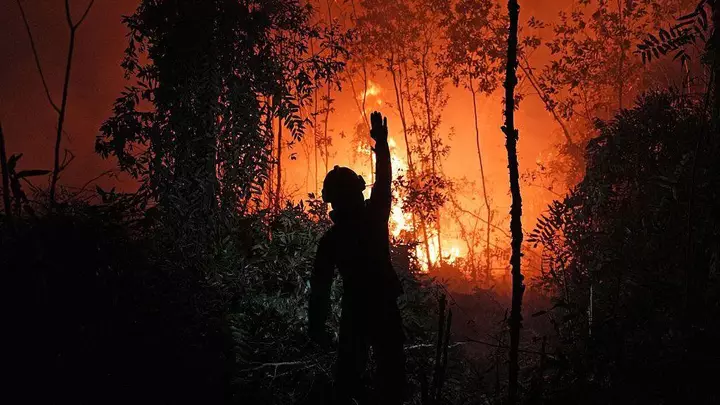
As Indonesia battles its worst wildfire season in a decade, a toxic smog is choking millions of residents in the region. The air on the islands of Kalimantan and Sumatra have turned an ominous amber, with air quality recorded at hazardous levels. The smog - also known as the haze - has also drifted beyond Indonesia's borders to neighbouring countries, raising public health concerns.
It has obscured Singapore's skyline and forced some schools to close in Malaysia. Now, anger is mounting at the companies accused of burning farmland - as well as the authorities who have struggled to stop them. The annual dry season wildfires have been especially intense this year because of an unusually strong El Niño - a natural climate phenomenon which changes weather patterns around the world.
According to independent forest monitoring platform Nusantara Atlas, 1,043,377 wildfire hotspots have been recorded in Indonesia, burning a total of 900,000 hectares of land. Many of these fires in Indonesia's forests and peatlands are caused by the razing of vegetation to clear land - a practice known as "slash and burn". This is an agricultural method that has traditionally been employed by farmers in Indonesia to create nutrient-rich soil for new crops.
But today, many of these fires are associated with commercial farming and are taking place on a much larger scale - and are harder to control. Activists and government investigations have repeatedly accused some companies of using fire as a cheap way to clear large swathes of land. While slash-and-burn farming is illegal in Indonesia, enforcement of a ban has long proven tricky.
But persistent haze this year has prompted Indonesian authorities to step up efforts to punish offenders. Indonesian President Prabowo Subianto has called for tougher sanctions against slash-and-burn farming, describing the practice as "ecological terrorism". Last month, Indonesian authorities announced they had suspended the operating licences of 26 companies linked to the wildfires and launched investigations into others.
Cases involving criminal elements would be taken to court, officials vowed. But it's not just Indonesian companies that have been embroiled in controversy amid the haze problem. A Greenpeace report published this month identified businesses based in Singapore and Malaysia which are linked to plots of land in Indonesia where wildfires are burning.
Extract — continue reading at the source.