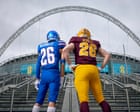
There have been as many college football games played in Tanzania and Italy (one) as there have in England, and twice as many in China and Australia. It’s nearly 40 years since 6,000 or so intrigued spectators watched Richmond Spiders beat Boston University in Crystal Palace. The 1980s was a time of international expansionism for American college sports, with games in Japan, Milan and Dublin.
They have returned to Ireland time and time again over the years. The College Football Classic has become an annual event at the Aviva Stadium in Dublin, where it has drawn in crowds of around 50,000 for the last five years, prompting the NFL to visit the city for the first time last September. It’s the other way round in London, where 20 years of NFL matches have paved the way for the college game.
The match between Arizona and Kansas at 5pm on Saturday – dubbed the Union Jack Classic – is an inevitable reaction to the NFL’s work in the city over the last two decades. The NFL have played 42 games in the UK so it seemed to be a mature enough market to bring college football here, versus breaking into a new market that might not have the appetite for the sport or the game. The timing just felt right.” Money and exposure.
College sport is becoming increasingly professional and universities want to keep the cash flooding in. The top coaches are paid more than $13m a year and the players are paid substantial sums for their image rights. Arizona and Kansas pay their squads around $20m a year.
Most of that money comes from TV revenue. Teams in the Big 12 bank nearly $32m annually from broadcasters, with games shown on ESPN, Fox, TNT, CBS, and NBC. Having an international presence is a very handy carrot to dangle to broadcasters.
It will be the first time they have ever taken that show international. They’re going to be here all week, making this game into something really big, not only here, but back in the US.” “I’ve always had global ambitions for the conference - it’s good for business,” adds Yormark. Football is a global sport.
Extract — continue reading at the source.