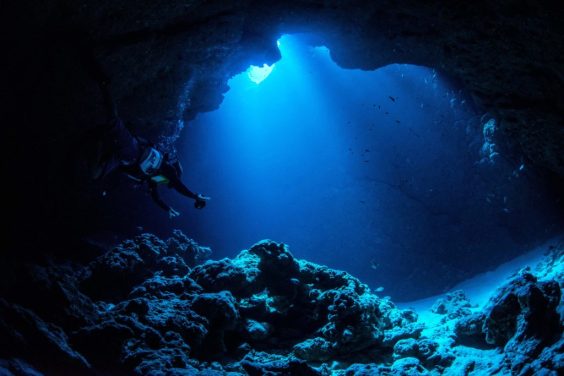
When people talk about the speed of light being a constant, they often leave out a very important qualifier: “in a vacuum.” Light waves travel slower through certain media, and the same is true of sound. In fact, sound can travel more quickly or slowly depending on differing characteristics of the same media. For example, sound travels at 1,500 meters per second in saltwater but slows down to 1,481 meters per second in freshwater.
The temperature, pressure, and dissolved impurities in saltwater can alter the speed of sound even more. It’s a lot to take into account when, say, using sonar to measure the depth of the deepest known point on Earth—the Challenger Deep located in the Mariana Trench. A new study published in Scientific Data goes on a deep dive (sorry) of all of the factors to take into account when measuring these tremendous depths, and it’s… a lot.
Read more: “When the Ocean Floor Came Alive” Because measuring the depth of the ocean involves so many “known unknowns” (to borrow a phrase from Donald Rumsfeld), scientists rely on a system of informed guesses or models. A team of Japanese oceanographers recently ventured out to the Challenger Deep on a research vessel to give five of these models a spin. They found that the maximum depth of the Challenger Deep’s eastern basin ranged from 10,914 to 10,932 meters—a spread of 18 meters—depending on the modeled speed of sound in seawater used.
Their preferred model relied on measures of the variables taken in 2023 at a depth of about 1,900 meters along with measurements taken in 1992 of the full depth. By combining the two, the team was able to take into account changes closer to the ocean surface with the rest of the water column properties. Using their preferred model, they estimated the maximum depth of the Challenger Deep is 10,927 meters (or 35,850 feet).
But the study also highlights other issues with measuring the depth of the ocean at such vast distances. For example, the sonar instrument they used has a two-degree-by-two-degree beam configuration, which sounds incredibly narrow. But by the time the sound beam travels the nearly 11 kilometers to the ocean floor, its footprint actually covers an area of 400 meters (over 1,300 feet) in both directions.
In other words, it’s not capturing some of the finer details of the area below. Additionally, the team found that the actual speed the research vessel is traveling can distort measurements more. We may never know the precise depth of the Challenger Deep, but the team has made their data available so we can keep on trying.
Extract — continue reading at the source.
/https://tf-cmsv2-smithsonianmag-media.s3.amazonaws.com/filer_public/8e/4a/8e4a8cb8-d60b-463c-8d75-b5e275fcb008/gettyimages-2295171651_1.jpg)
/https://tf-cmsv2-smithsonianmag-media.s3.amazonaws.com/filer_public/9a/87/9a87a020-0686-4a21-9b46-712a66884535/fix.png)
/https://tf-cmsv2-smithsonianmag-media.s3.amazonaws.com/filer_public/b1/75/b1753ed1-7500-46e3-8bd7-3c6c9bf0a99e/menopause-brain.jpg)
/https://tf-cmsv2-smithsonianmag-media.s3.amazonaws.com/filer_public/2a/43/2a43872b-3e44-4548-8a9d-d5b7190a2469/soft-archaeology-1200x630.jpg)