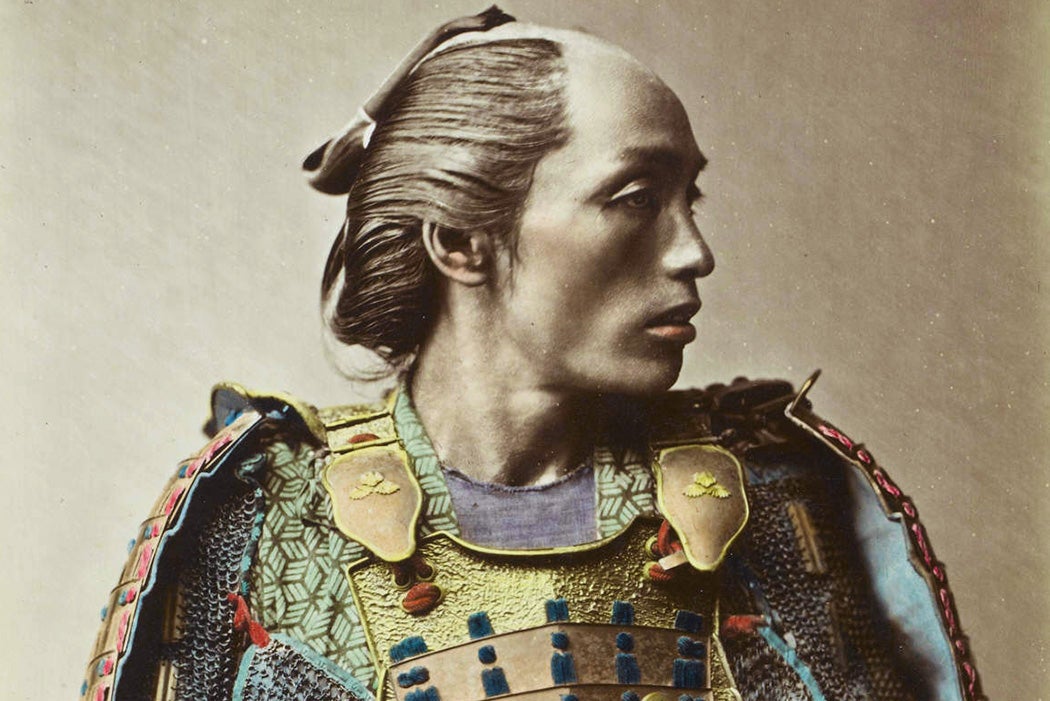
The right-wing movements that emerged around the world in the mid-twentieth century were both highly nationalistic and willing to work across borders. And, as Michele Monserrati, a scholar of modern Italian studies, writes, that helps explain why Italian Fascists were obsessed with samurai. Monserrati writes that Italians, and Europeans in general, got many of their ideas about samurai from a 1900 book by Japanese diplomat Nitobe Inazō, a strong supporter of Japan’s colonization of Korea.
Titled Bushido: The Soul of Japan, the book was written in English to convey a vision of Japanese culture to a Western audience. It presented the samurai as similar to the chivalric knights of European legend, propelled to victory by honor, courage, and loyalty. This image influenced the Italian view of the Russo-Japanese War of 1904–1905, in which European journalists presented the Japanese soldiers as samurai-like paragons of discipline and self-sacrifice.
Monserrati writes that this was inspiring stuff for many young Italians, who—much like many in Japan—were frustrated with their country’s minor position in geopolitics and interested in modernization and building an imperial power. Samurai imagery gained prominence during World War I, which many right-wing Italians viewed as an opportunity to reinvigorate a militaristic form of nationalism. One of these thinkers was Bartolomeo Balbi, who translated Bushido and other Japanese books.
In particular, he was interested in the idea of honorable death, including ritual suicide. He likened seppuku to the mythological story of the Roman soldier Marcus Curtius, who rode his horse into a chasm to save Rome from destruction. Shimoi Harukichi, a Japanese writer from a samurai lineage, moved to Italy in 1915 and worked to align the nationalism of the two countries.
He identified Fascism as a spiritual movement comparable to the bushido warrior ethos. In one wild anecdote, Monserrati writes that Shimoi helped engineer an invitation from the Japanese soft drink company Calpis to have Mussolini offer an “inspirational message” to Japanese youth. Il Duce delivered a speech highlighting the commonalities between bushido and Fascism.
With actual samurai sidelined as Japan modernized in the nineteenth century, Italians were able to cherry-pick the aspects of the samurai’s image that they found most relevant. Some Fascists admired Japan’s use of Shinto shrines and ritual to endow its militaristic nationalism with spiritual power. Others were particularly interested in Zen Buddhism, which Japanese thinkers including D.T.
Extract — continue reading at the source.



/https://tf-cmsv2-smithsonianmag-media.s3.amazonaws.com/filer_public/6f/61/6f6104c5-5a61-4d34-97e6-3dbac1a73fb8/original.jpeg)