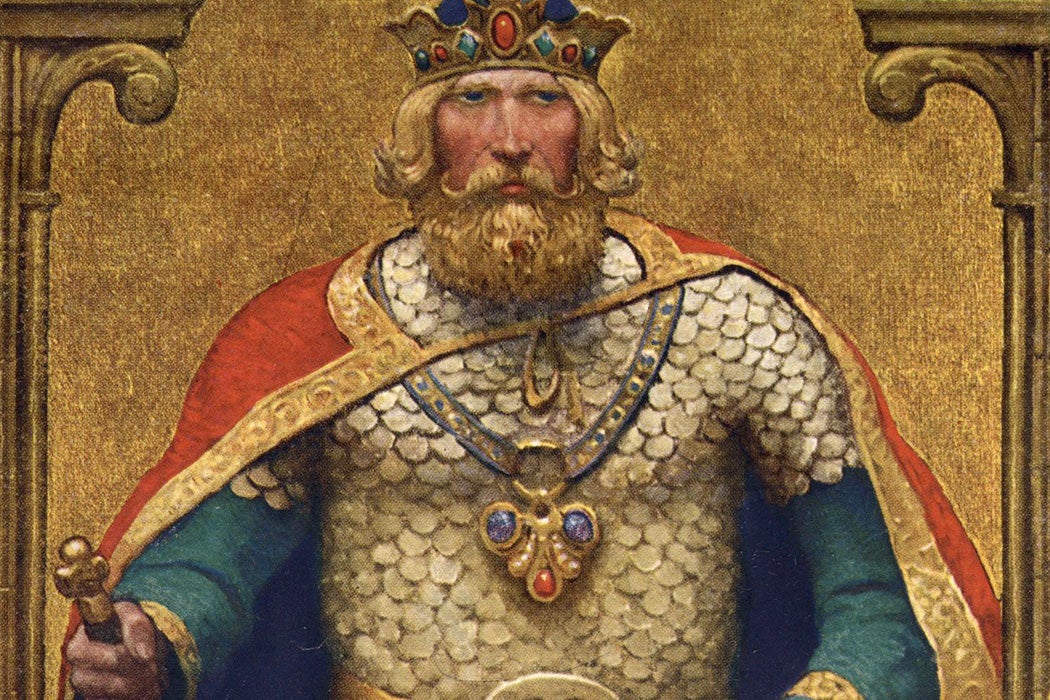
The Matter of Britain has had an enduring influence on popular media, from films and documentaries to commercials and music videos. Avalon, Camelot, the Holy Grail, and Excalibur have found a place in popular music, entertainment, and consumer culture of the twentieth and twenty-first centuries, as have Merlin, Guinevere, and other familiar figures. In 2026 alone, the music video for Troye Sivan’s 2026 single “Party” is set in an Arthurian-like landscape, complete with dramatic cliffs and grasslands and a queer-coded equivalent to the Knights of the Round Table.
That summer, fragrance brand Ffern released a short inspired by the legend of The Green Knight. Its color grading recalls dreamy 1980s fantasy films more than the grim, dark cinematography associated with Game of Thrones and fantasy settings from the 2010s onward. In 2027, director Anna Biller of The Love Witch fame will release the fairytale-like feature The Face of Horror, with medieval settings and Technicolor-like visuals.
Arthur and the chivalric culture he evokes remain part of our cultural lexicon, as shown by his continued reimagining in popular media. Examples include the 1981 Excalibur film, which interweaves four narrative threads: the sword in the stone, the Arthur-Guenevere-Lancelot love triangle, the quest for the Holy Grail, and Mordred’s ascent. More recent films include King Arthur (2004), The Last Legion (2007), Arthur and Merlin (2015), and King Arthur: Legend of the Sword (2017).
Excalibur, in particular, became a blueprint for Arthurian-inspired music videos and commercial shorts. They use the music video for New Order’s 2015 single “Restless” to discuss how the Matter of Britain continues to influence popular media, despite the inconsistency in the quality of these tributes. They argue that the video’s borrowed aesthetic signals an Arthurian universe rooted in late-twentieth-century popular media.
Its fragmented narrative assumes viewers recognize Arthurian tropes and motifs, which, for the average consumer, may be more closely associated with Boorman’s film, T.H. White’s The Once and Future King, Disney’s animated classic The Sword in the Stone, or even Marion Zimmer Bradley’s Mists of Avalon series. However, in the case of “Restless,” New Order seems to challenge the cookie-cutter versions of Arthur that have been over-consumed and shared by the middle class in favor of a punk reinterpretation of Arthurian material.
Moreover, the video positions “the Arthurian Material as a means to explore the tensions and anxieties that threaten domestic family life and to express a skeptical and suspicious view of the middle-class fantasy of order, justness, and safety that Arthur has come to embody in Western culture.” The two more recent examples that came after the article’s publication fit the same Boorman-inspired aesthetic paradigm, combining lush visuals with a fairytale-like, artificial color palette. Troye Sivan takes an intentionally classicized and queer approach to the Knights of the Round Table, while Ffern’s short film for its “Green Knight” fragrance offers a gender-bending interpretation of the universe. The film emphasizes the pagan elements of Arthurian myth and uses an elaborate, dreamlike style to emphasize Ffern’s commitment to craft, ingredients, and creativity, as well as its stance against AI.
Extract — continue reading at the source.