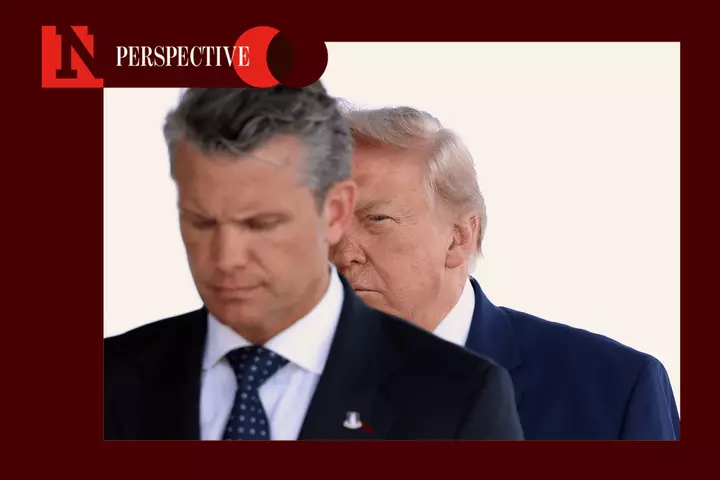
Bush walked into the East Room the day after his party’s midterm defeat—a "thumping," as he put it, three years into Iraq and five for Afghanistan—and announced that Donald Rumsfeld was leaving the Pentagon. President Donald Trump just received an almighty thumping of his own, mostly because of his own Middle Eastern adventurism in Iran, which blew back as a painful energy price pinch on already hard-pressed Americans. Since Tuesday night, the president has reportedly been asking advisers whether his embattled Defense Secretary Pete Hegseth should stay.
Yet when Trump was asked about replacing Hegseth, who has led the military strategy in the still-unresolved Iran war, he demurred: "No, I think he’s doing a very good job." It looks like stubbornness, perhaps even loyalty. But Vice President JD Vance has blamed the defeat squarely on Iran. Hegseth is, by Trump’s own admission, the first adviser to "speak up" and urge that war.
"Let’s do it," the president recalled him saying in March. The midterms certainly gave Trump strong cause to drop Hegseth and try to deflect some of the blame for Iran onto his warrior-in-chief. But Hegseth is a unique character to have at the Pentagon.
And he perhaps remains more helpful to Trump than a liability. Trump is, after all, a president with no election left to win, facing a Congress newly empowered to say no. Does he have much use for a more-conventional defense secretary who can make peace on Capitol Hill?
Or a gung-ho maverick who reliably says yes? By that narrow, unsettling measure, losing Congress may have made Hegseth more valuable to Trump, not less. This logic has a recent precedent, though it’s not one that Bush followed.
Days before the 2006 vote, Vice President Dick Cheney vowed to press ahead in Iraq whatever the result: "We’re not running for office." Bush changed defense secretaries anyway. Two decades on, the roles have flipped. Now it is the vice president—who may yet face voters again if his 2028 ambitions weren’t also a victim of Iran—counting the war’s political cost, and the president, who cannot, insisting he still would have done it again anyway.
Extract — continue reading at the source.