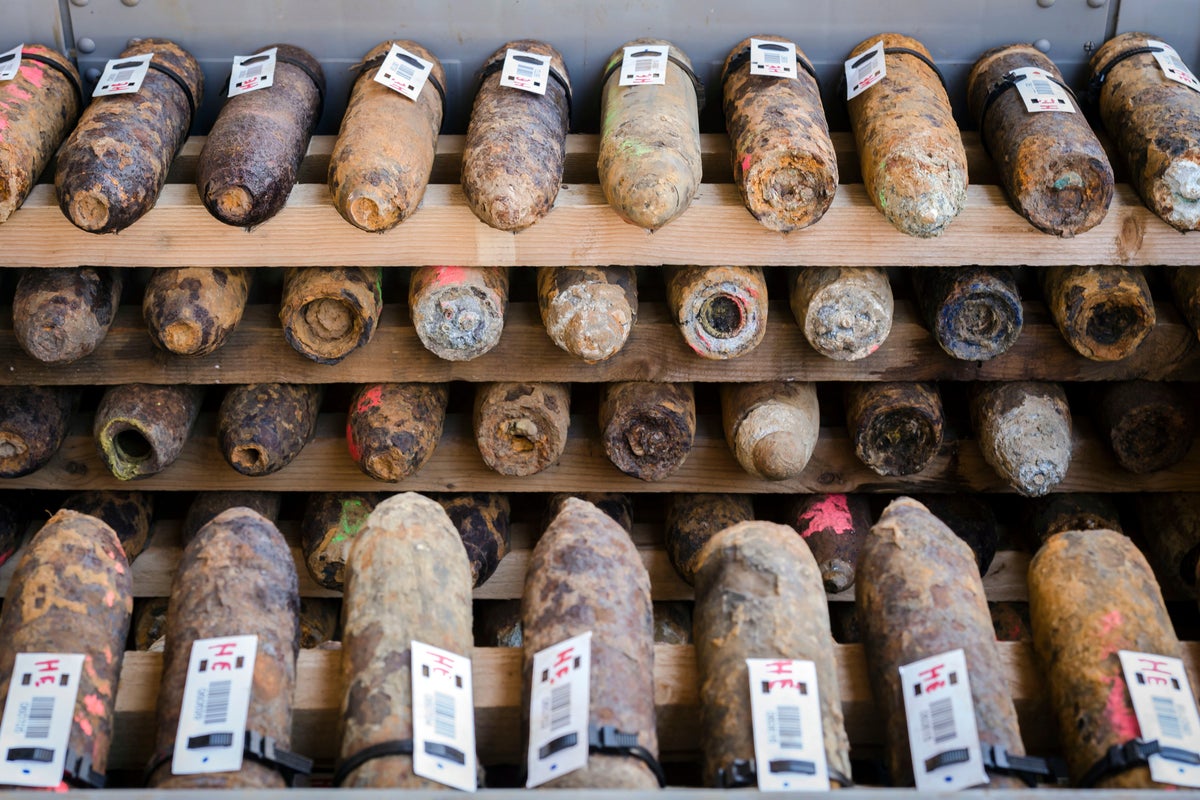
Scorched landscapes across Europe have exposed a potentially lethal threat lurking underground. Rusted bombs and mines from the First and Second World Wars are now endangering emergency crews responding to the wildfires across the continent. High heat has caused several weapons to explode in France, Belgium, Germany and the Netherlands.
In the Dutch province of Limburg, a bomb-disposal team was called out to inspect woodland near the site of heavy 1944 combat threatened by flames. Exacerbated by climate change, the blazes and detonations show that Europe’s "climatic luck" is ending, said Sarah Njeri, a peace and conflict scholar at London’s School of Oriental and African Studies. Consistent temperatures and predictable rain previously kept hidden weapons dormant.
"Climate change is now doing the work of unburying and reactivating what was previously stable," Ms Njeri said. Blazes can ignite vintage munitions and clear away the dense brush concealing them. Heavy rainfall in January spurred vegetation growth that turned to kindling when summer heat arrived.
Coupled with drought, low humidity and stiff winds, the temperatures created optimal conditions for fire, according to a World Weather Attribution study published in July. As they advanced, the flames moved over territory that has long been known to hold unexploded weapons, a lethal legacy that lingered long after the guns of the World Wars fell silent. In a forest in tinder-dry France, a massive wildfire outside the southwestern city of Bordeaux uncovered a cache of what is believed to be Second World War-era ammunition.
In the eastern Belgian province of Liege, Governor Hervé Jamar said that “a few sporadic detonations" were recently heard and that emergency services were adapting to account for munitions buried in fire areas. He said that no fire crews were in danger, but local media published photos of a firefighter handling a rusted bomb. During the Second World War, booby traps, bombs and mines were sprinkled throughout the province's dense peat-bog forest, which is known as the High Fens.
In the first four years after Germany’s surrender in 1945, the munitions killed six civilians, said Bernard Collard, a local historian who runs the Truschbaum Museum near Belgium's border with Germany that houses a collection of found objects from the war. The fire in the High Fens, which stretches across the border with Germany, is smouldering atop a much-bloodied battlefield where Nazis fought Allied troops in the famed Battle of the Bulge. The fire is even closer to the sites of two lesser-known skirmishes along Elsenborn Ridge and in the Hurtgen Forest, which lasted 88 days and saw about 33,000 American and 28,000 German troops killed.
Extract — continue reading at the source.