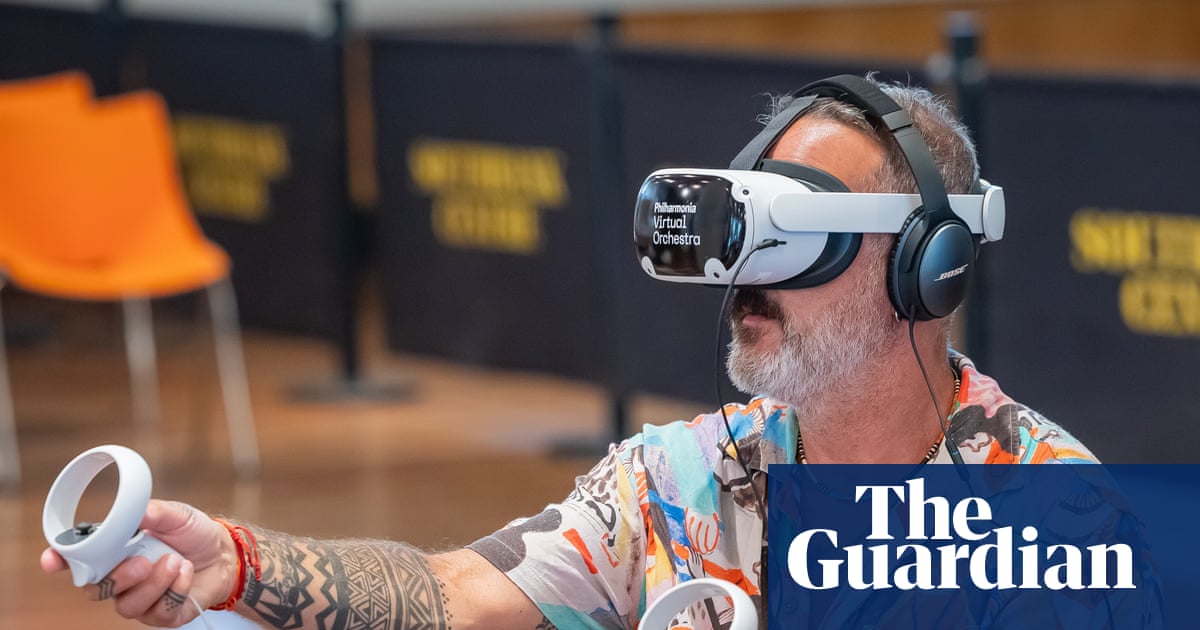
I’m about to perform with the Philharmonia Orchestra and I’ve not rehearsed my part. In fact, I’ve not even seen the score. Or played my instrument before.
Nervously taking my place among the virtuosos, I look around: the brass, string and woodwind sections are all warmed up and ready to be led by the energetic conductor, Santtu-Matias Rouvali. Then I glance up at the audience: the Royal Festival Hall is packed to the rafters. You’re offered the choice of triangle, cymbal and timpani (the last is “definitely the most fun”, Génova assures me) and after a quick run-through of the sounds you can get from your instrument, courtesy of Philharmonia percussionist Tom Edwards, you’re thrown into a rehearsal and then the actual performance.
I’ve barely had time to say “How do I hold these sticks again?” before the strings start swelling, Rouvali waves his baton and a musical score starts hurtling across the bottom of my vision. Oh God, I think, am I about to screw this up? The Philharmonia have a history of using cutting-edge technology to help them stand out from the other big London orchestras.
They were founded in 1945 as a “recording orchestra”, back when such a thing was still a novelty, and more recently they’ve provided immersive digital orchestral experiences, lighting up the walls of places such as the Science Museum. The move to interactive headsets is the next logical step in trying to engage new audiences – no previous musical or VR experience is required to join this orchestra. The headsets’ main purpose, however, is educational.
The Philharmonia have developed a programme of activities that can be completed as part of the national curriculum. The aim is not for students to fully learn instruments virtually (I’m impressed with how realistic the mimicry is but it can’t completely replace the subtleties of an actual instrument). Rather, the hope is that it sparks interest in playing – and encourages users to seek out the real thing.
The scheme was spurred on by recent research highlighting declining music participation in schools, with GCSE Music entries falling 27% since 2010. The Philharmonia is signed up to the Orchestra in Every School programme, a scheme designed to ensure every child in the UK has access to live music-making and high-quality music education. The feedback from the 428 children in year 7 involved was overwhelmingly positive.
Extract — continue reading at the source.