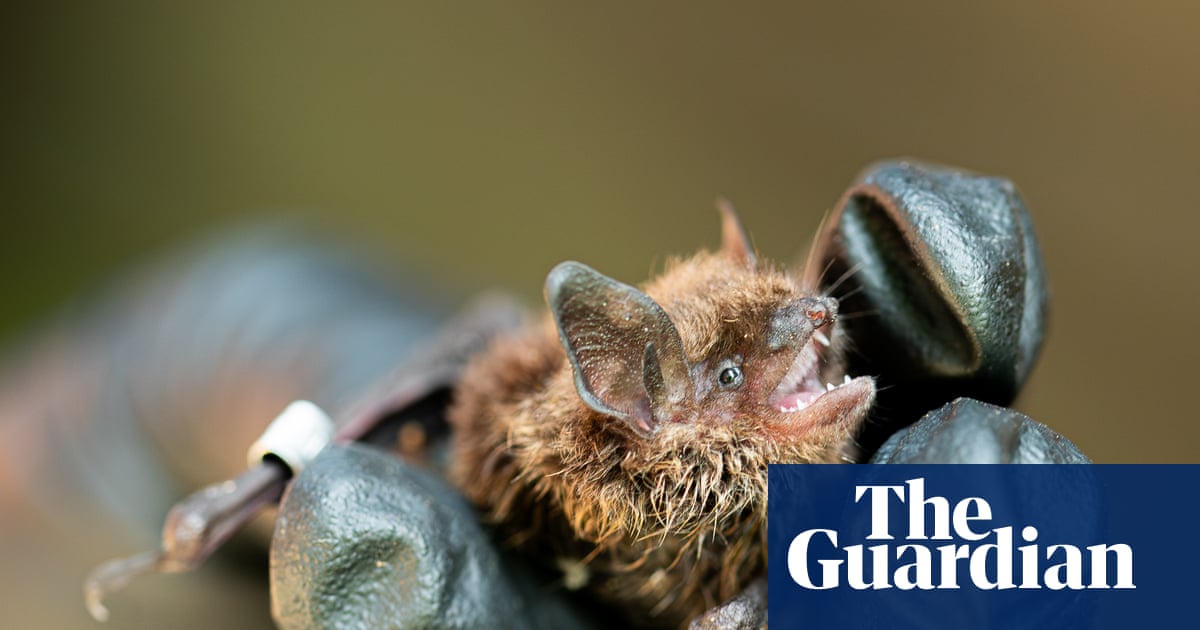
Crawling through a narrow passage in a cave beneath a boreal forest near Fort Smith in Canada’s Northwest Territories in May, two biologists spotted a lifeless bat on a limestone ledge, its body covered in a spindly white fungus. When they shone their headlamps to get a closer look, they saw another bat with the fungus on its forearms. For Reimer, an ecologist specialising in bat populations in northern Canada and Alaska, there was little doubt.
For 20 years, white-nose syndrome, a lethal disease caused by the fungus Pseudogymnoascus destructans (known as Pd), has swept west across North America, spreading from bat to bat and cave to cave, killing more than 6.7 million bats. The fungus attacks their face, wings and arms while they are hibernating. They stir from rest and groom themselves, burning through the fat and energy reserves they need to survive the winter, and eventually die from dehydration or starvation.
Smaller bats with lesser fat reserves are particularly at risk. Now it had reached Fort Smith, a town about 450 miles (725km) south of the Arctic Circle. They had hoped to do a baseline survey of healthy, stable populations before the fungus arrived.
In 2025, white-nose syndrome had been discovered in a cave in Fort McKay, Alberta, nearly 200 miles south. Now the fungus has reached the northernmost-known hibernaculum, where bats shelter during the North American winter, it has raised urgent questions about its potential impact on bat populations in Canada and Alaska, Reimer says. The caves near Fort Smith were first discovered in 2010, when a wildlife technician flying over the area noticed a distinctive karst feature below.
A karst landscape is formed when bedrock such as limestone or dolomite dissolves, forming underground caves and sinkholes that provide an ideal habitat for wintering bats. The technician later hiked back on foot and confirmed it was, indeed, a hibernaculum. Two additional caves were found in the region.
Until then, biologists had not known where the Northwest Territories’ hibernating bat species – including little brown bats (Myotis lucifugus), big brown bats (Eptesicus fuscus) and northern long-eared bats (Myotis septentrionalis) – were spending the winter. They had located summer colonies, or roosts, which tipped them off that bats were sticking around through the winter months, but they did not know where or in what numbers. The 11-chambered cave shelters an estimated 3,000 bats, making it the largest hibernaculum in western Canada.
Extract — continue reading at the source.