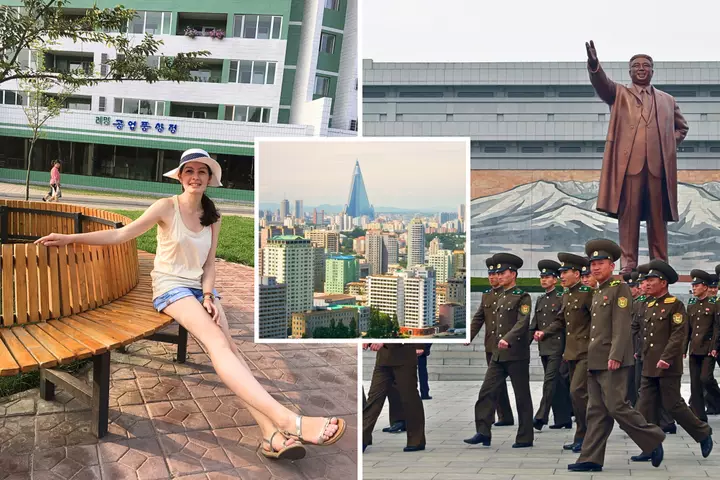
For just a few months, Diana Karabegovich lived a life that few in the U.S. will ever experience—or desire to. On the surface, her student exchange days sound surprisingly ordinary. The 28-year-old, then 19, took classes, completed homework, hung out in cafés, played volleyball, and went swimming.
Except, Karabegovich was studying in North Korea, one of the most isolated and tightly controlled countries on Earth. "I graduated from Moscow State Institute of International Relations, majoring in international economic relations, with Korean my first language at university," Karabegovich, who lives in Moscow, Russia, told Newsweek. "As part of my studies, I received two scholarships to do an exchange program, one in North Korea at Kim Il-Sung University and one in South Korea at Hankuk University of Foreign Studies.
The experience offered unusual access to everyday life inside the Democratic People’s Republic of Korea (DPRK), far beyond what most visitors—of which there are strikingly few—encounter. Yet, Karabegovich’s memories of a fairly laid-back time consisting of warm hospitality and new friendships exist alongside a more troubling reality. North Korea is a hereditary totalitarian dictatorship where the state exerts control over the information its citizens are allowed to consume and how they express.
Human rights organizations have recorded severe abuses within the country's borders. A recent report by a Seoul-based NGO documents that some of those sentenced to death had been charged for consuming foreign cultural content, including K-pop. Karabegovich's unconventional study abroad program took her to both countries occupying the divided peninsula.
For the student, who later ran a blog about North Korea, experiencing both Koreas was integral to understanding the region. "Students in North Korea have much more freedom than tourists, who have to stick to a group and a guide, whereas students can roam on their own." While foreign visitors are rarely granted access to North Korea, Karabegovich's entry was rather straightforward. Her college in Russia covered her tuition and travel fees, while Kim Il-Sung University paid for her dormitory and food.
She applied for a visa through the North Korean Embassy in Moscow and, after the university supplied the required confirmations, she was able to fly to Pyongyang. Once there, student life settled into a demanding rhythm. "On Saturday, we had one speaking class, and Sunday was our day off.” Outside class, she said students would typically complete homework and spend their spare time socializing.
Extract — continue reading at the source.