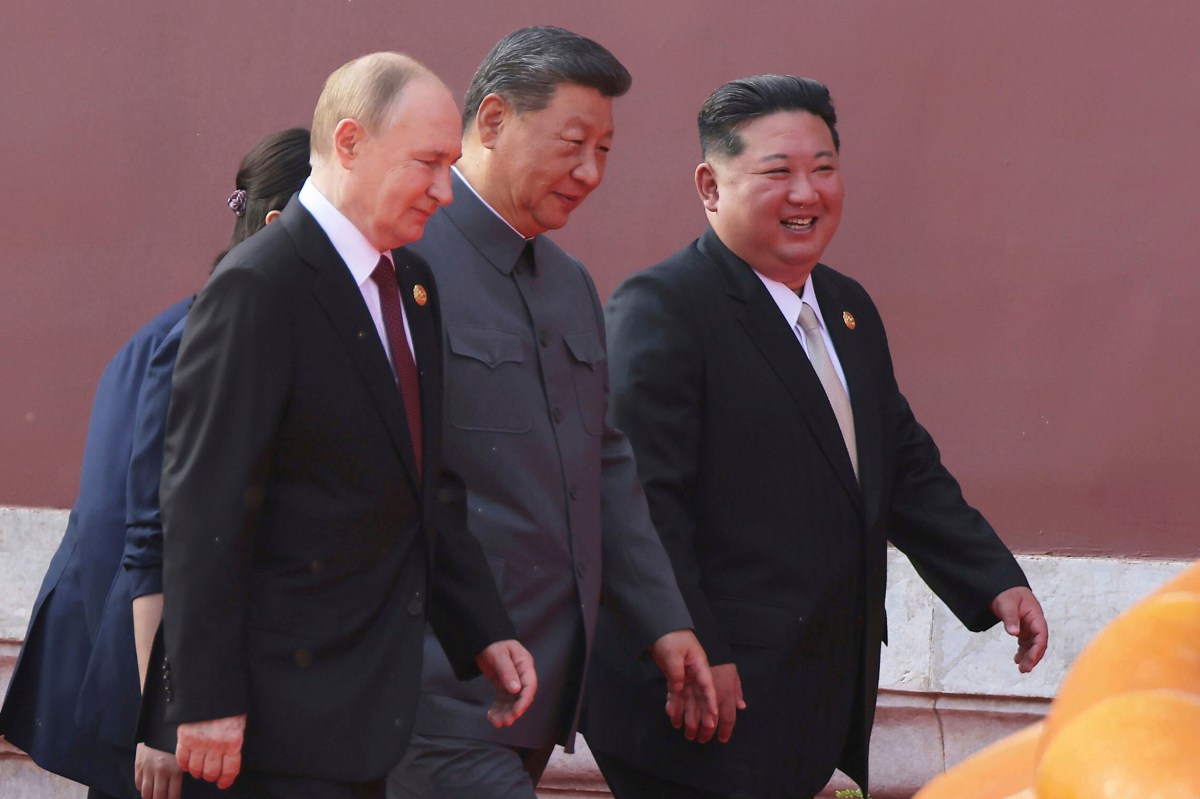
Navy's only actively deployed aircraft carrier in the Asia-Pacific to aid operations in the Middle East, Washington's top three rivals in the region have only stepped up challenges to U.S. partners. Reports first emerged earlier this month that a new aircraft carrier would be sent to relieve the USS Abraham Lincoln, amid concerns raised by sailors' families over deteriorating conditions aboard the ship after a deployment exceeding 260 days—far beyond the standard six-month tour—in support of operations against Iran. The replacement was later confirmed to be the USS George Washington, now en route to U.S.
Central Command's (CENTCOM) area of operations from a port visit to Vietnam. But as the last carrier leaves the western Pacific, a trio of U.S. challengers consisting of China, Russia and North Korea have only ramped up military activities. "I'm sure they're quite happy about this deployment," Raymond Kuo, vice president of research for geostrategy and diplomacy, told Newsweek.
"While the U.S. still has ground and air forces at regional bases, the absence of a carrier group means Washington has lost its key power projection tool. We are much less able to contest Chinese and Russian naval and coast guard operations." "The deployment also suggests that CENTCOM doesn't have the necessary means to defeat Iran without drawing from other regions," Kuo said. "This calls into question America's capabilities in a future conflict against more powerful opponents, all while reducing U.S. military readiness right now for no strategic gain." While the aircraft carrier gap limits military options in the region, the U.S. continues to maintain a number of bases, including aircraft and warships.
The absence is also likely to be temporary. Navy maintains 11 nuclear-powered aircraft carriers, although usually around half are actively deployed at any given time. Options to replace the USS George Washington in the western Pacific region include the USS Theodore Roosevelt, which is preparing for a possible deployment from San Diego later this year, and the USS Carl Vinson, which is currently underway in the eastern Pacific following upgrades, renovations and maintenance.
In addition to the USS Abraham Lincoln, the USS George H.W. Bush carrier strike group is also operating in the Middle East. Ford departed the region in May amid a post-Cold War record deployment of 326 days that spanned support for NATO in the Arctic, the U.S. intervention in Venezuela and the U.S.-Israeli war against Iran, during which a reported laundry room fire forced the ship to undergo repairs in the Mediterranean.
But Trump's latest carrier shuffle was accompanied by other developments that have raised concerns about U.S. military readiness, including a pause in arms sales amid dwindling munitions stockpiles due to the war on Iran, as well as Trump's announcement Sunday that he would order the Pentagon to scale back joint military exercises with South Korea. Trump criticized South Korea for not sufficiently supporting the U.S. in its conflict against Iran and suggested that the annual drills were "totally inappropriate and hostile" toward North Korea at a time when Pyongyang had been "unthreatening and respectful." While North Korean Supreme Leader Kim Jong Un has avoided direct criticism of Trump, who has described his relationship with the ruler as "very good," North Korea has pressed on with hostile rhetoric toward U.S. allies South Korea and Japan. Last Wednesday, authorities in Seoul and Tokyo reported Pyongyang's second ballistic missile launch in less than a week in actions viewed as a likely protest against the scheduled joint U.S.-South Korea exercises.
Extract — continue reading at the source.