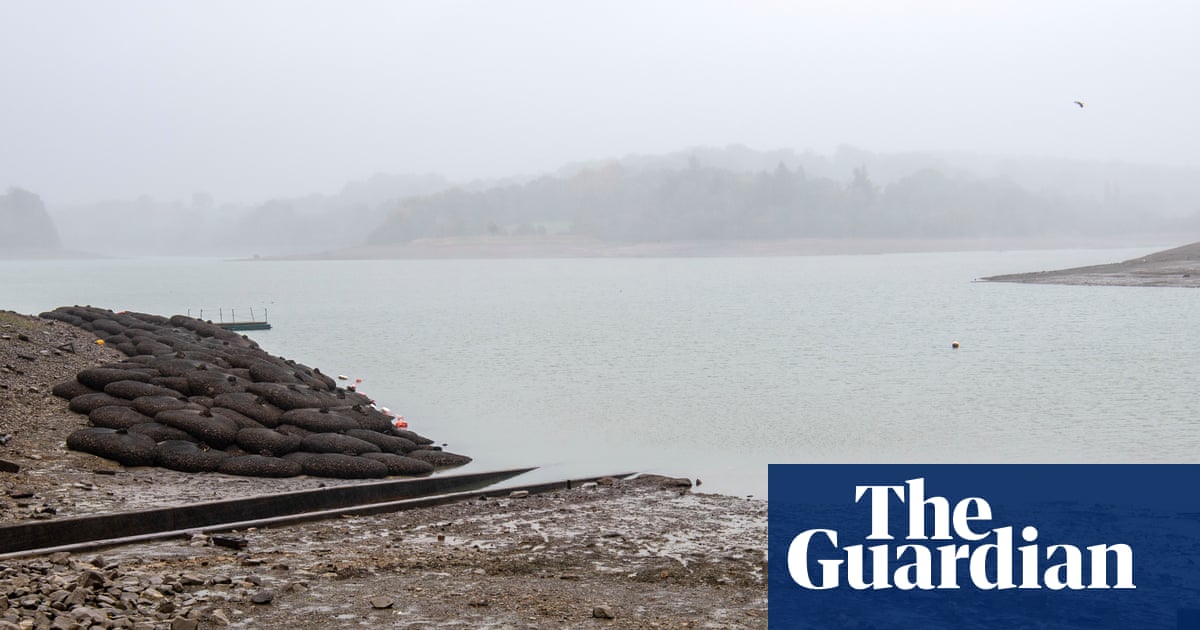
I don’t remember ever seeing it this low,” says Caroline Allan, a lifetime resident of Haywards Heath, the nearest town to one of England’s most depleted reservoirs. The Ardingly reservoir, managed by South East Water and serving about 95,000 properties in and around Haywards Heath and Uckfield in Sussex, is currently 19% full. The day the Guardian visited, the weather was grey and rainy, incongruous with the muddy reservoir bed that should have been submerged under six metres of water.
Earlier this month a severe drought was declared in parts of Devon, Cornwall, Dorset, Somerset, East Sussex and West Sussex, with urgent measures being taken to secure public water supplies after the UK experienced its hottest summer on record. Severe drought is the highest level of drought and is declared when evidence shows drought is causing or will soon cause serious harm, and when emergency action is needed to protect people, water supplies, the environment, farming, infrastructure or other critical services. There has been a steady stream of new housing developments around Haywards Heath, sparking local opposition, with concerns that a growing local population is putting pressure on already strained resources.
Water demand is increasing as the population grows and new industrial demands from datacentres and energy infrastructure require more water. Plus, the water available to supply those needs is reducing as the climate crisis worsens, resulting in greater variability and unpredictability of rainfall and greater water demand during hotter, drier summers. There has also been a lack of investment over several decades in fixing leaks and building new reservoirs.
Most of Europe has endured back-to-back climate crisis-driven heatwaves this summer. The extreme heat, coupled with little rainfall, means 82% of England and large parts of Wales are still in drought or severe drought. The Environment Agency would expect reservoir storage to be about 75% at this time of year and yet supplies at several reservoirs are critically low.
This includes Ardingly and Wimbleball, which supplies South West Water customers and is 14.5% full. It is estimated that 120% of average rainfall is needed between now and April for all areas to be considered out of drought. The government’s national drought group was told on Wednesday that despite the “weather whiplash” brought by Storm Austen and Boelo, the recent rain has not changed the drought outlook.
Less than six miles away from Ardingly, Southern Water’s Weir Wood reservoir is 80% full because a water treatment works at the site has been out of action since 2018. I think that’s madness,” Allan said. Graham Ward, who has lived in Haywards Heath for his whole life, also said it was “crazy” that there was a full neighbouring reservoir that cannot be used.
Extract — continue reading at the source.