This article has been reviewed according to Science X's editorial process and policies. Editors have highlighted the following attributes while ensuring the content's credibility: Sounds have shapes. That might sound strange since sound waves are invisible, but a famous psychological experiment in the 1920s showed that our brains naturally link spoken sounds to visual forms.
According to new research published in Proceedings of the Royal Society B, dogs may do this too. As in the classic experiment, researchers in this study played recordings of made-up sounds like "Bouba" and "Kiki" while monitoring how participants responded to sharp or smooth visual images. This time, the subjects were 70 pet dogs recruited by researchers led by Eleonora Biffi at the University of Parma in Italy.
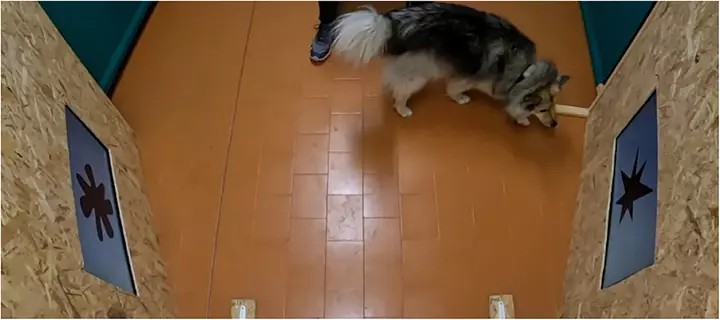
But getting dogs to reveal what they're thinking is no easy feat. There were two experiments, and the first involved 51 pet pooches and their owners taking part in four 30-second trials. Each dog and owner entered a room set up with two screens placed side by side.
One screen displayed a spiky black shape while the other showed a rounded black shape. Meanwhile, speakers behind the screens played either the sound "Bouba" or "Kiki" 15 times (once every 2 seconds). During the first 20 seconds, owners held their dogs still in front of the screens while the audio played.
A camera recorded each trial, and the footage was later analyzed by AI to track the direction of each dog's head to calculate where it was looking. For the final 10 seconds, owners released their dogs to freely explore the screens and inspect the room. To ensure owners didn't inadvertently tip off their pets with subtle body language, researchers ran a second experiment with 19 additional dogs.
Here, owners wore headphones playing music so they could not hear the test sounds. In both experiments, dogs spent significantly longer looking at rounded shapes while hearing "Bouba" and at spiky shapes while hearing "Kiki." During the free exploration phase, dogs in the first experiment spent more time exploring the spiky shape when "Kiki" played. However, in the second experiment, they showed no preference for either shape while exploring.
Extract — continue reading at the source.


