It’s October 2001, and you’re standing in a dimly lit game store, where rows upon rows of boxes sit in anticipation as you glance across their titles, unsure exactly which among them you'll end up taking home. Unfortunately, you can only pick one. Your eyes are already darting between Devil May Cry, Silent Hill 2, and Ico, which all feel eerily attuned to those pre-Halloween vibes.
Noticing your indecisiveness (and the look of impatience on your mother’s face), the store clerk strides over with an assist, placing in your hands a game you had never heard of until that very moment. The artwork’s nothing to write home about, just a collage of pictures in red, blue, and green hues, featuring obscure faces, a police chopper, and a car up in flames. Your instinct is to just go with your gut; Silent Hill 2 is what you came here for, after all.
But something’s telling you otherwise. Maybe it’s the store clerk going on about its open-world premise, or the name itself that strikes a chord within you. Whatever reason incites it, you make the ultimate decision.
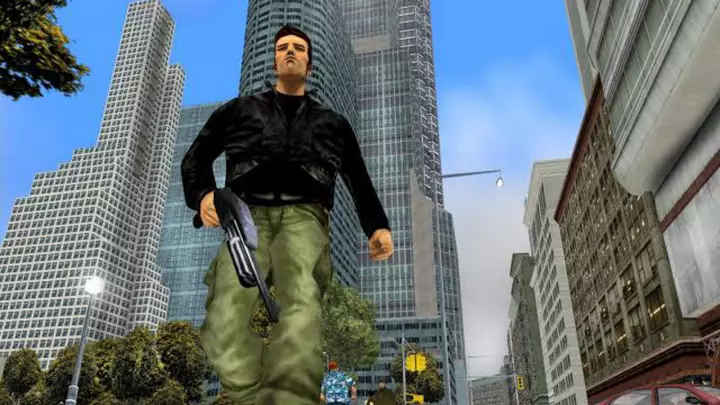
Little did you know, you’d be walking home with one of the greatest achievements in video game history. Grand Theft Auto 3 was a jolt of raw adrenaline. It was a paradigm shift that made the possibilities of 3D open-world design feel almost limitless.
The game thrust players into what Rockstar co-founder Dan Houser described as “an old, post-industrial American city,” a mash-up of Chicago, Pittsburgh, Detroit, Philly, and mostly New York teeming with grim alleyways, pedestrian-filled streets, and sky-slicing buildings that eclipsed many of the incredible worlds that came before it, from The Legend of Zelda: Ocarina of Time to Driver. It was called Liberty City. No game had molded such immense verticality into a 3D world that felt like a living ecosystem where the inhabitants and environments reacted to you directly.
It was a feat many at the time considered impossible on existing hardware — and Rockstar did it with virtually no load times to boot. Like nearly every title the studio would develop for the system, GTA 3 pushed the PlayStation 2 to its absolute limits. Developers DMA Design (now known as Rockstar North) had to cleverly stream around 130MB of data, including 3D animations, textures, models, and audio, through the PS2’s 32MB of system RAM.
Extract — continue reading at the source.