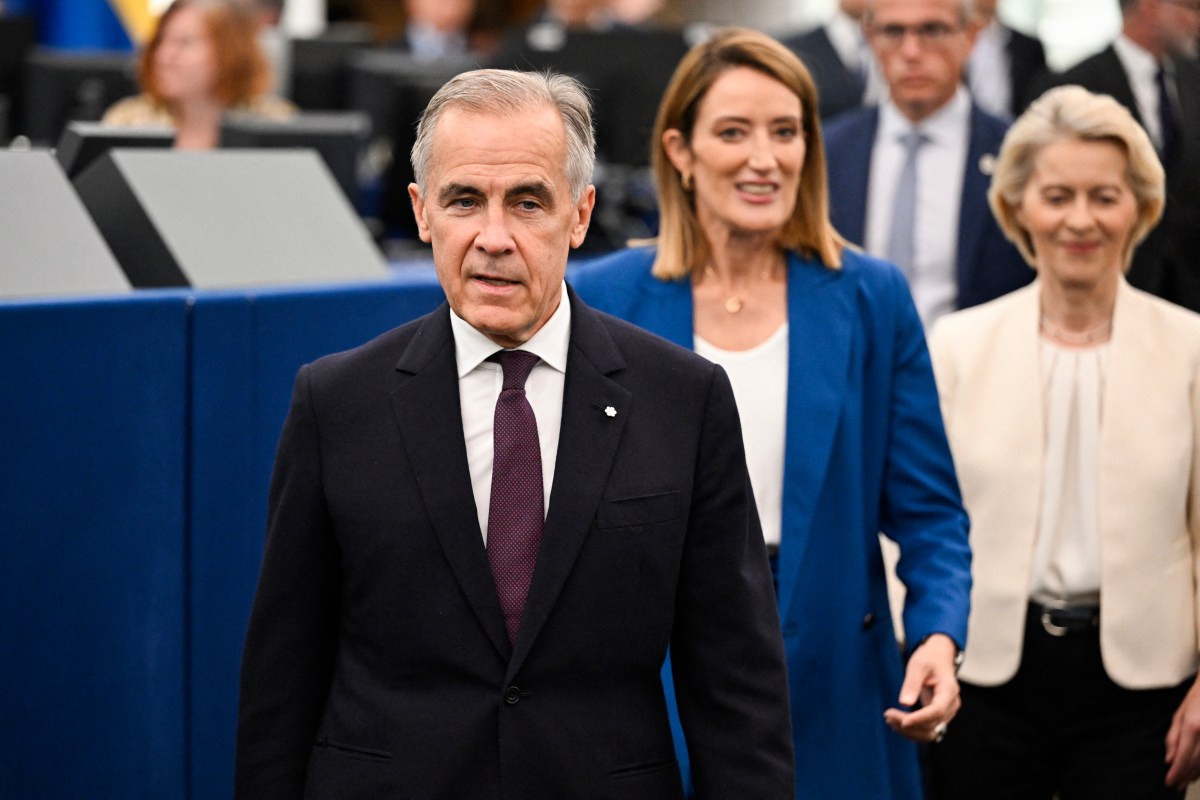
When Mark Carney told the European Parliament on Thursday that economic integration has become a form of leverage, it was an argument delivered in Strasbourg but pointed squarely at Washington, D.C. Canada’s deteriorating relationship with the U.S. was the orange-hued specter hanging over the prime minister’s speech to his European friends. What Carney was proposing with Europe, he insisted, was not “a great-power rival, only with better manners.” "We do not seek power to dominate others,” the mild-mannered Carney said in Strasbourg.
Carney got a standing ovation. A day earlier, European Commission President Ursula von der Leyen had proposed making Canada the European Union’s first associate member. Trump called the idea potentially “hostile,” and threatened much heavier tariffs on Europe if he deemed it so.
His tariffs, his demands for economic concessions, and his repeated talk of a 51st state have sharpened Ottawa’s incentive to reduce its exposure to the U.S. Having looked earlier to China, Carney is now turning to Europe in his pursuit of greater autonomy from Canada’s southern neighbor. But how far can diversification actually alter an economy built around continental integration?
On the evidence, not as far as the applause for Carney in Strasbourg suggests. Canada can change governments, treaties, and alignments. But it cannot change the map.
After a year of determined diversification, 66.3 percent of Canadian merchandise exports still went to the U.S. in July. The infrastructure beneath is where Carney’s politics cannot reach. Global Affairs Canada counts more than 100 cross-border oil and gas pipelines and electricity transmission lines, and reports that about 94 percent of Canadian crude exports to the U.S.—roughly 4 million barrels a day—move through transboundary pipe.
Energy alone is about 29 percent of what Canada sells to the U.S. All of that infrastructure connects Canada to the U.S. None of it reaches a market—a heavily fortified one at that—across an ocean.
Extract — continue reading at the source.