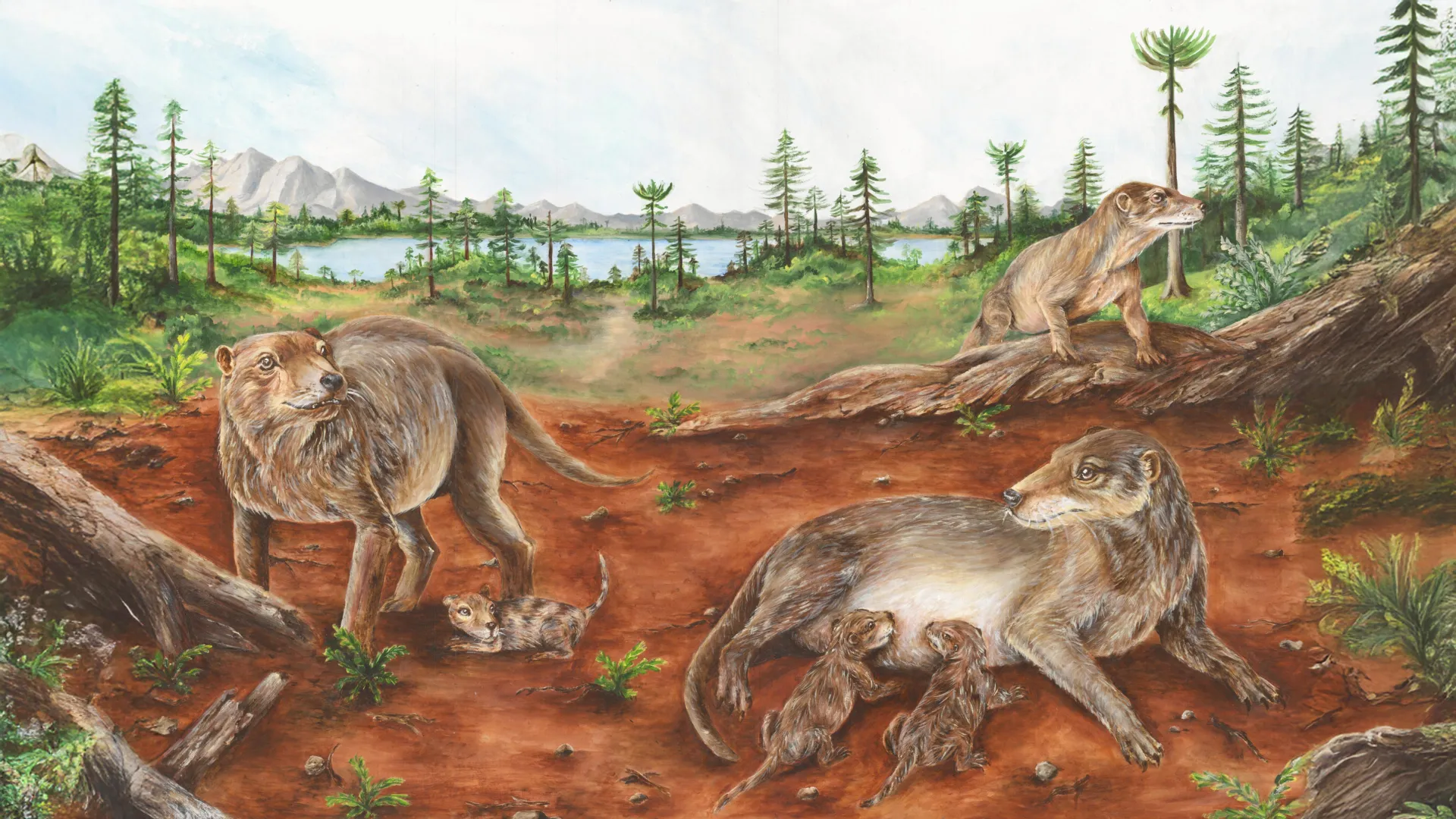
Some cynodonts may have started giving birth to live young far earlier in evolutionary history than scientists once believed. A new study published in Frontiers in Mammal Science presents the first compelling evidence that at least some cynodonts may have been viviparous -- meaning they gave birth to live offspring. "We show for the first time that live birth was present in at least one mammalian ancestor, Chiniquodon theotonicus, which lived approximately 236 million years ago," said lead author Dr.
Leandro Gaetano, a paleontologist at the National Scientific and Technical Research Council (CONICET) in Argentina. "This implies that viviparity among early cynodonts originated in the mammalian lineage at least 95 to 90 million years earlier than previously thought." A Longstanding Mystery About Mammal Reproduction "Cynodonts thrived in the Triassic, a period of recovery and restructuring of ecosystems after one of the most devastating mass extinctions in life history," explained senior author Adriana Mancuso, a researcher at CONICET who focuses on the evolution of terrestrial ecosystems. "This meant high competition for resources and strong predatory pressures.
Combined with a trend toward aridity and strong seasonality, embryos of viviparous species would be better protected than those of egg-laying species." The investigation began during a postgraduate course, when researchers noticed an unusual growth mark in the microscopic structure of a fully grown C. theotonicus fossil discovered in northwestern Argentina. Comparisons with living animals suggested that the feature was a neonatal line, a distinct growth ring that can occur in bones or teeth. Such lines form in response to the sharp acceleration in growth that takes place shortly after birth.
To investigate whether this interpretation was correct, the researchers estimated the animal's body mass as a newborn and compared it with its adult body mass. They then compared those values with data from several thousand living mammals, non-avian reptiles, and birds. "If mammalian ancestors were egg-laying or viviparous has been considered an inscrutable mystery," said Gaetano.
"We came up with a somewhat ingenious set of methods to get at something very difficult to analyze in the fossil record." The researchers used measurements from the fossilized bones to estimate how large and heavy the C. theotonicus individual was at birth and at death. The neonatal line provided information about its size at birth, while the outer surface of the bone reflected its final size. Their calculations indicate that the animal weighed about 1.7kg when it was born and roughly 12kg when it died.
That means the newborn C. theotonicus was about 14% of the body mass it eventually reached. That ratio is striking when compared with living reptiles. Some turtles, snakes, and crocodilians weighing between 8kg and 14.5kg produce hatchlings that weigh only nine to 53g.
Extract — continue reading at the source.