Astronomers from MIT and other institutions have identified an exceptionally bright red object dating back to the early universe. At first glance, it resembles an enormous star with dimensions comparable to our solar system. Its energy output, however, is extraordinary.
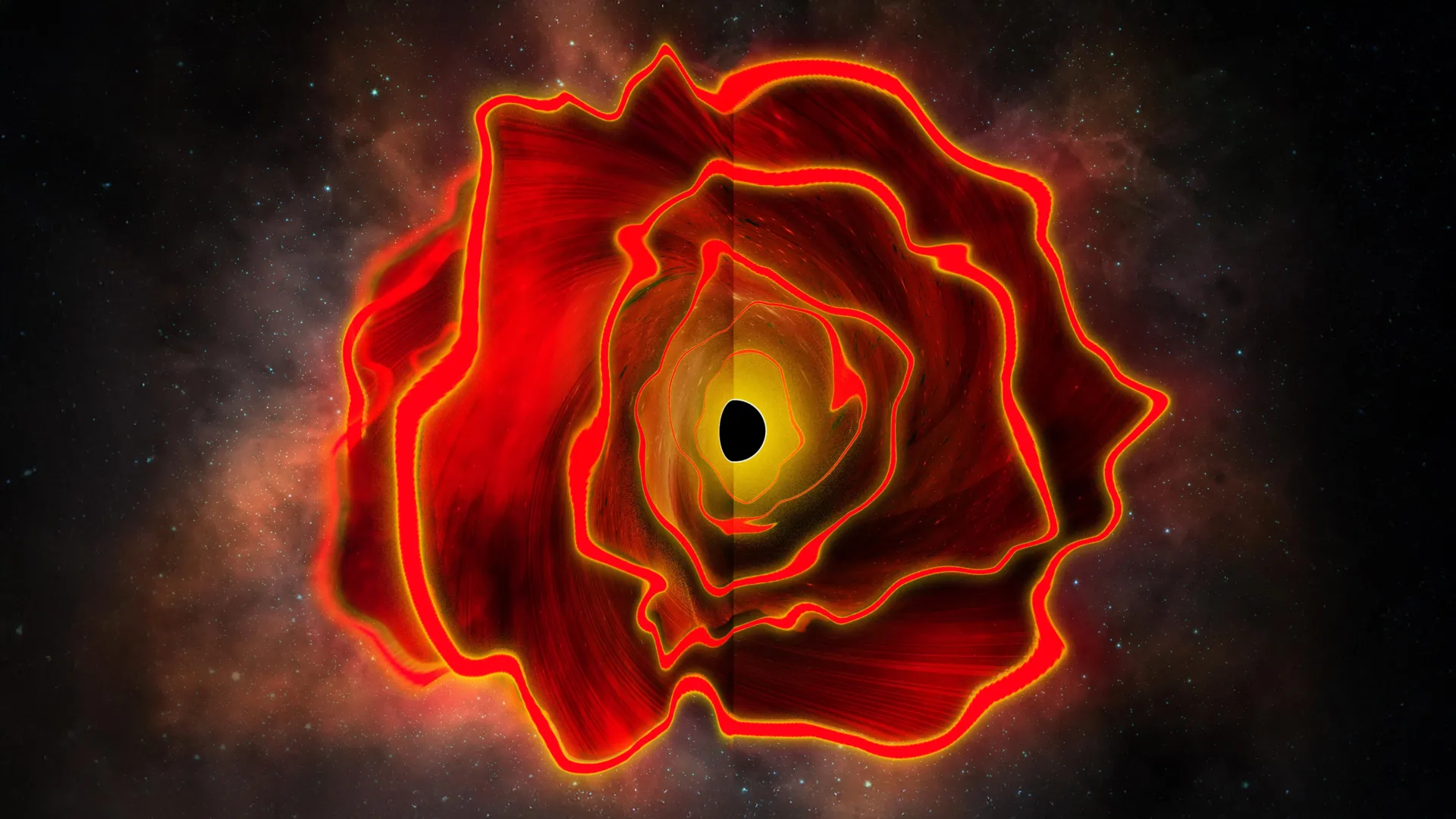
The object is producing roughly 100 billion times more energy than any known star could physically generate, putting its power much closer to the levels associated with black holes. That unusual combination has led researchers to propose that the red object represents an entirely new kind of astrophysical source. They are calling it a "black hole star." A study published on August 12 in Nature describes the object and the team's analysis of observations made with NASA's James Webb Space Telescope (JWST).
The telescope detected the bright red dot in the very early universe, only a few hundred million years after the Big Bang. A Black Hole Hidden Inside a Giant Star Like Cocoon The researchers say the most likely explanation is a previously unseen combination of a black hole and a star. Instead of being powered by the nuclear fusion that fuels ordinary stars, the object may consist of an extremely dense cloud of gas energized by a black hole at its center.
"Our picture of this object is evolving very rapidly," says lead author Rohan Naidu, a NASA Hubble Fellow and Pappalardo Fellow at MIT's Kavli Institute for Astrophysics and Space Research (MKI). "We think there is a central black hole that is 100,000 times as massive as the Sun. And around this black hole, there would be this very extended envelope of gas that looks like a star the size of the solar system.
It's huge." If the interpretation is correct, the discovery could also help explain the mysterious "little red dots" that have appeared in nearly every deep space image taken by JWST. "These little red dots seem to be everywhere in the early universe but essentially disappear by the present day," Naidu says. "What exactly these objects are has been one of the most debated topics of the JWST era." The study's MIT coauthors are MKI Director Robert Simcoe, the Bruno B.
Rossi Professor of Experimental Physics; and Wendy Sun '26, along with researchers from several other institutions. An Unexpected Discovery in the Early Universe Naidu and his colleagues were not originally searching for a black hole star. Their goal was to identify some of the earliest and most distant galaxies through a survey called "Mirage or Miracle" (MoM).
Extract — continue reading at the source.