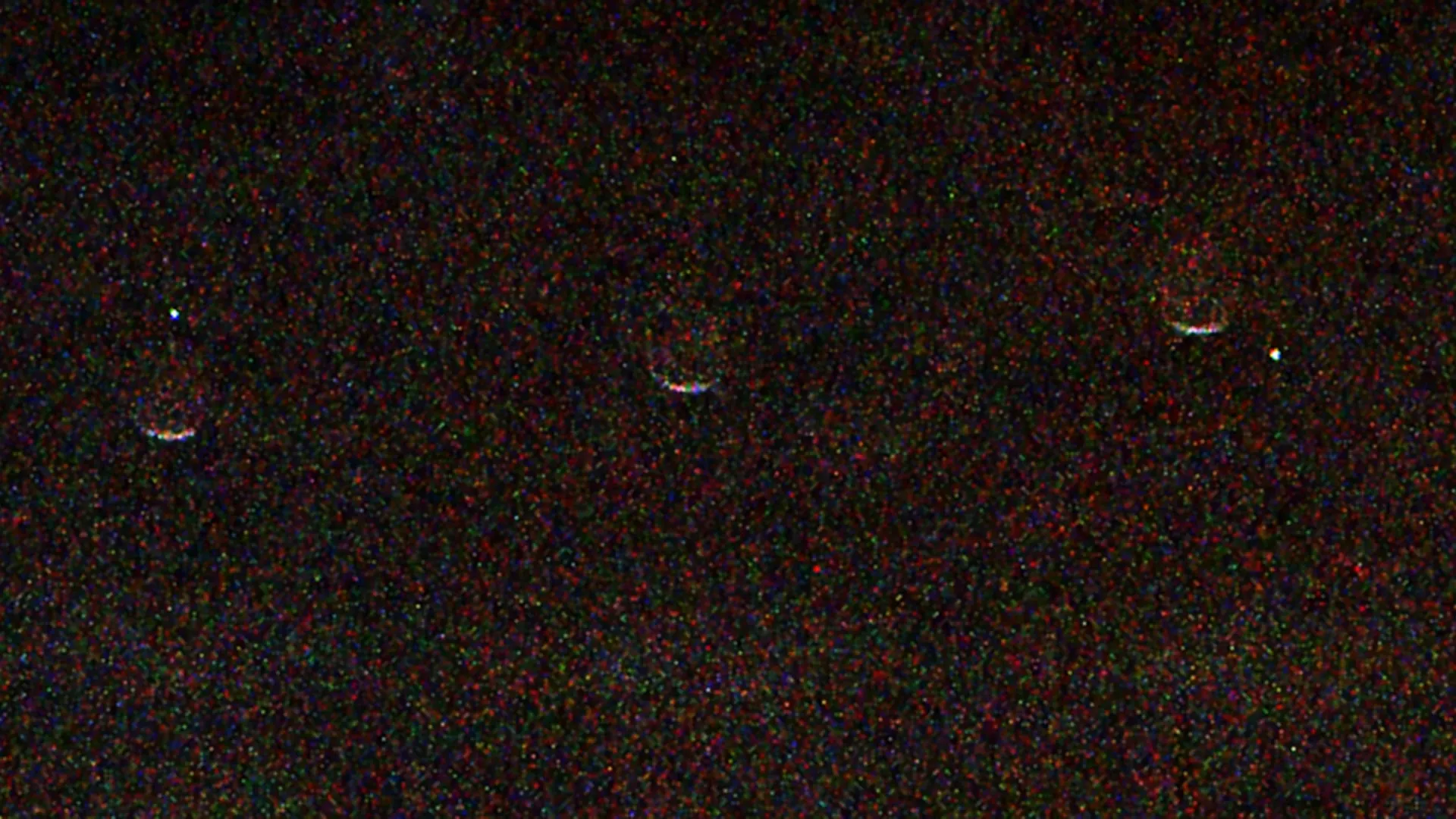
NASA's Perseverance Mars rover has captured a remarkable celestial sight: Earth briefly vanishing behind Phobos in the evening sky of Mars. A newly released sequence of images shows Earth as a tiny point of light while Phobos, the larger of Mars' two moons, moves across the sky and passes directly in front of it. The observation marks the first time humanity has recorded Earth disappearing behind another object from the surface of a different planet.
Earth Vanishes in the Martian Evening Sky Perseverance recorded the sequence with its Mastcam-Z instrument at about 7 p.m. local solar time (the Martian evening time where the rover is located) on July 2, the 1,907th Martian day, or sol, of the mission. In the composite view, Earth moves diagonally from the upper left toward the lower right. Phobos travels in the opposite direction, crossing from the lower left toward the upper right.
By the third image in the sequence, the two objects line up, and Earth briefly disappears behind the shadowed edge of the small moon. "The composite image makes for a unique Earth self-portrait, taken from the surface of another planet, with a Phobos photobomb," said Justin Maki, the Mastcam-Z deputy principal investigator and imaging scientist for Perseverance at NASA's Jet Propulsion Laboratory in Southern California. A Tiny Earth Seen From 195 Million Miles Away From Perseverance's location along the rim of Mars' Jezero Crater, Earth and Phobos present a dramatic contrast in both size and distance.
Phobos is a lumpy, potato-shaped moon about 17 miles (27 kilometers) across at its widest. Because it orbits only 4,850 miles, or 7,800 kilometers, from Mars, it appeared about one-third as wide as Earth's Moon appears from our planet when Perseverance took the images. Earth, meanwhile, was about 195 million miles (314 million kilometers) away.
At that enormous distance, our entire planet appeared in the images as only a single-pixel-sized point of light. "Phobos crosses the Martian sky three times a day, and Earth is visible for months at a stretch, but catching one directly behind the other takes planning and a little luck," said Mark Lemmon, a Mastcam-Z co-investigator at the Space Science Institute in Boulder, Colorado, who planned the observation and assembled the composite. Astronomers describe the event Perseverance witnessed as an occultation.
This happens when an object that appears larger from the viewer's perspective completely blocks a more distant object behind it. It occurs when one object enters the shadow of another. When the Moon moves through Earth's shadow, the event is known as a lunar eclipse.
Extract — continue reading at the source.