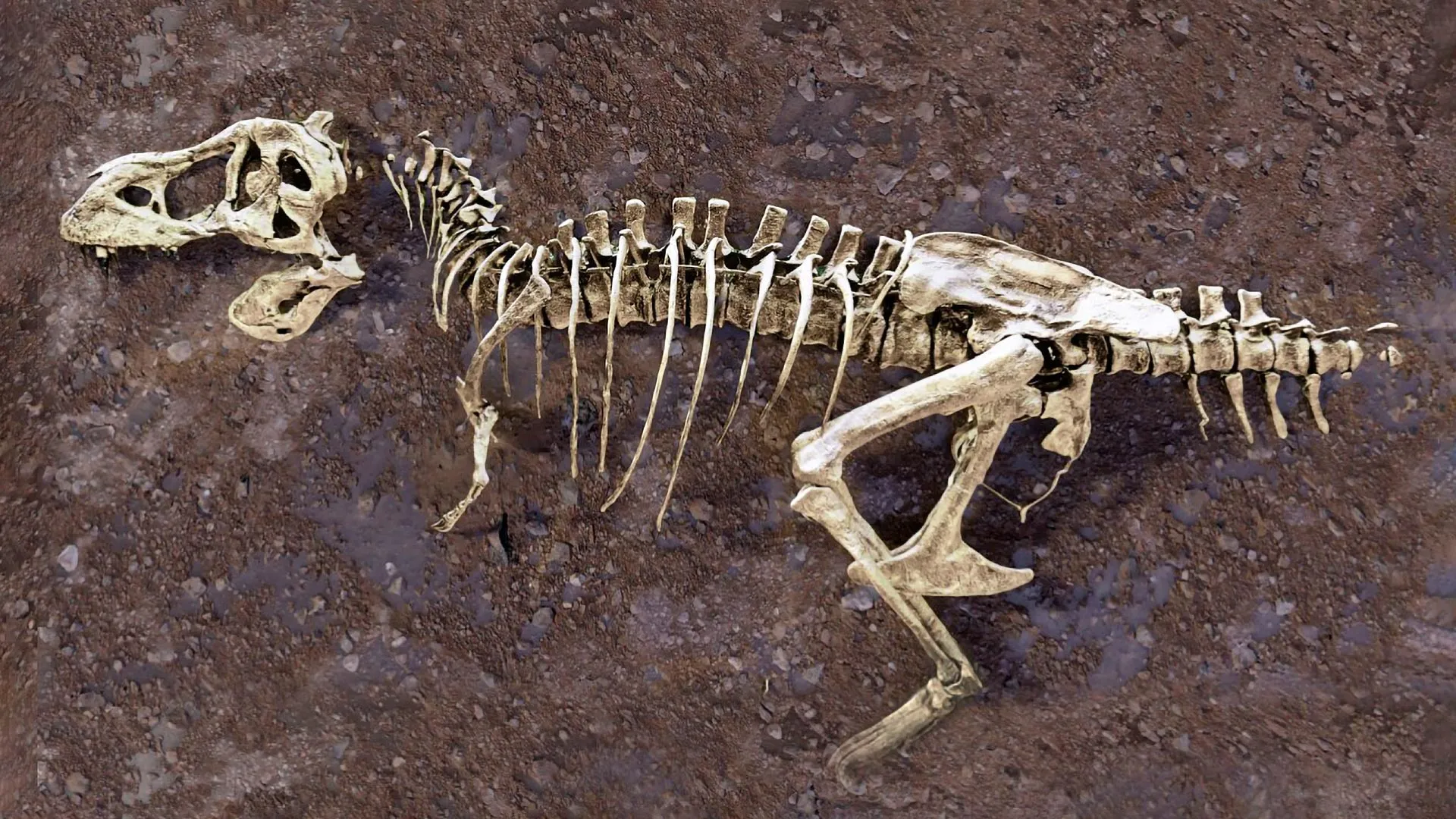
A fractured rib from Scotty, the largest Tyrannosaurus rex skeleton ever discovered, is giving researchers a rare look at dinosaur biology from 66 million years ago. Preserved inside the bone is something almost never found in the fossil record: evidence of an injury that was still healing when the animal died. Scientists used neutron imaging at the Department of Energy's (DOE) Oak Ridge National Laboratory (ORNL) to examine the fossil from the inside.
The technology allowed them to construct detailed 3D images without damaging the preserved soft tissue. "It's like winning the lottery," said Mauricio Barbi, professor of physics at the University of Regina (U of R) in Saskatchewan, Canada. "Scotty's rib contains a vast network of mineralized blood vessels that has never before been observed in a fossil." Fossilized Blood Vessels Preserve a Rare Moment Soft tissues such as blood vessels usually disappear during decomposition long before fossilization is complete.
Scotty's rib is an unusual exception, preserving delicate structures that provide a glimpse of what was happening inside the dinosaur's body while the injury was healing. After the rib broke, iron rich blood entered the injured area and new blood vessels formed as part of the healing process. Scotty died before the fracture had completely healed.
The dinosaur ended up in a salty marsh, where conditions slowed decomposition and helped preserve the fragile network of blood vessels. "Every fossil is a tiny snapshot of the past," said Jerit Mitchell, a U of R doctoral candidate in physics who leads the project under Barbi's direction. Scotty's remains were discovered by teams from the Royal Saskatchewan Museum in Saskatchewan's Frenchman River Valley, one of North America's richest sites for dinosaur fossils.
Rocks in the region preserve an important record of dinosaur life shortly before the mass extinction that ended the age of nonavian dinosaurs. Researchers are also studying fossilized amber, dinosaur scales and bones from other dinosaurs. "By piecing the clues together, we understand the past and how things could evolve in the future," said Marcella Berg, a U of R assistant professor of physics and former ORNL postdoctoral researcher.
Neutrons and X-rays Reveal a Dinosaur Medical Record Neutron and X-ray imaging provide researchers with complementary ways to see inside materials. Neutrons are particularly useful for detecting light elements on the periodic table, especially hydrogen, while X rays are highly effective at revealing heavier elements. The contrast is somewhat similar to the difference between an MRI, which can emphasize soft tissues such as muscle, and an X ray, which is especially useful for viewing dense structures such as bone.
Extract — continue reading at the source.