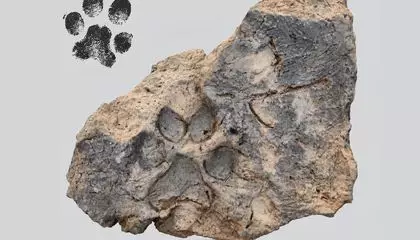
Archaeologists know that much from excavating its ruins, which were found in modern-day Turkey. The stories of the humans who built the structure have been lost to history. But one of the mud bricks unearthed in the rubble features an intriguing clue: a dog’s paw print, which survived undisturbed for 4,000 years.
The house is located at Tavsanli Hoyuk, an archaeological site in western Turkey. Archaeologists from Bilecik Seyh Edebali University have been conducting excavations there since 2021. Tavsanli Hoyuk began as a village some 8,000 years ago.
Flooding later covered the land, but settlers returned in roughly 3200 B.C.E., at the beginning of the Bronze Age. Humans inhabited the site continuously for the 1,500 years that followed. But then, around 1700 B.C.E., attackers appear to have burned it down.
Archaeologists have unearthed spearheads, arrowheads and daggers dating to this period. Previous excavations also revealed the remains of two victims of the attack, who were found beneath the ruins of a house. Officials announced the discovery of the brick marked by a paw print on October 26.
During the Bronze Age, workers made mud bricks by mixing water, soil and straw, according to a statement from Bilecik Seyh Edebali University. Workers would have poured this mixture into a mold, which then hardened in the sun. As this particular brick dried, a dog left a distinctive imprint featuring four round toe pads.
The approximately 4,000-year-old paw prints discovered at Tavsanli Hoyuk provide a particularly direct and touching glimpse of this relationship.” Earlier this year, a study published in the journal Nature found genetic evidence of a domesticated dog that lived in what is now Turkey 15,800 years ago. Fidan points to this study, explaining that humans in the region have had a close relationship with dogs for thousands of years. Quick facts: The oldest domesticated dogs “Of course, we cannot determine whether this particular dog was kept as a pet in the modern sense,” Fidan tells IFLScience.
Extract — continue reading at the source.